Well, I’m still here in case you were wondering – or even if you couldn’t care less (in which case, I don’t suppose you’d be reading this). Regardless, here we go…
For over a year, I went kicking and screaming into a sudden and uncertain reality. In the process, I have slowly, often unwillingly, been discovering who I am in the midst of loss, pain, and sorrow. The world I thought would never change – changed – without any warning. NOT FAIR!
I reasoned (something my A.D.D. brain should know by now to question) that it was time for a change. So, I packed up my former self, one box, one picture, one memory at a time. I suddenly realized I had been trying to suppress the uncertainty of my future with superficial words and inadequate certitudes, “I’m fine. Really!” – even though it may appear that I’m losing my shit!
Some “experts” encourage us to act “as if” _________(fill in the blank) until it becomes our truth. So, I did – or at least I tried. But, in pretending I was already there, I believe I also denied the necessary process of change. So, does acting “as if” my life is often a total shitstorm count? Because right now it is – no acting required.
Jen Hatmaker beautifully describes the inevitable change of seasons in life, “It can be difficult to envision a new start but impossible to deny one. This is your work. No one can do it for you. Something doesn’t have to be bad to be over. That season has possibly given you everything it had to offer; it shaped and developed you, and it stretched and inspired you. We are not entirely rebranded with each new season; we simply build the next layer. As a testament to our design, we are capable of preserving the best of each season while rejecting the worst. The human heart is shockingly resilient. We need to get better at permission and grace.”
The pictures are packed up now, leaving bare walls and lots of nail holes my husband never knew about because, well, why measure when you can just eyeball distance, even if you suck at it! I didn’t take the time to count, but I’m pretty sure there were at least five or six holes behind each picture!
But I digress…
It has become clear to me that I have been stuck in the past. God tells us to stay out of there and move on, trusting Him every step of the way. The past certainly formed my identity to this point, and I am grateful for all of its lessons. But that’s not the end of my story or my journey. Hatmaker says, “You can care about new things and new beginnings and new people. Carry on, sister!” Carry on, indeed!
(Tenor GIF)
God wants me, wants all of us, to boldly step into each new day, believing every life experience, good or bad, will influence how we impact our world. Our loving God has created our most outlandishly gifted, magnificently designed selves for that very purpose.
It’s time to grab onto the desire of my heart that has been sitting too long and aching to be acknowledged, that one passion refusing to fade away no matter how much I have tried to ignore it.
Joe Newman is 107 years old. Anita Sampson, who recently celebrated her 100th birthday, is Joe’s fiancée (you read that right). Joe said he has survived two World Wars, the 1918 Flu Pandemic, and the Great Depression. His advice after reflecting on all he has lived through? “Always look on the bright side. Don’t spend time worrying about what’s going to happen since what will happen will happen.” He says the coronavirus is just another event in his life and believes we should look forward to whatever time we have, be it years, weeks, or just days, and then hope for another one. Maybe work on those wedding plans – or not. (Anita has reportedly demanded a “Promise” ring by Tuesday, or she’s moving back to her own rocker!) But, for now, it’s nap time.
Since there are now so many American Centenarians, there have been several studies regarding these 100+-year-old folks. They all have survived so much. They have lived through misery, hunger, job loss, financial ruin, the loss of loved ones, and every imaginable heartache along the way. But that’s not the whole story. There are also beauty and blessings intermingled with suffering.
The most common and inspiring thread was just as I suspected. During the Depression, people who went beyond simply surviving learned to support and care for each other. They were generous with a few extra dollars, food from their gardens, and emotional support. Many discovered a deep well of strength and optimism that carried them beyond those tough times. They had a shared sense of gratitude, kindness toward others, and even a feeling of being blessed in the midst of unimaginable hardships. They learned acceptance of circumstances you cannot control. And hope – always hope.
Today they will tell you that happiness and fulfillment come from helping others; having a positive and optimistic attitude. Most have a strong faith and a deep commitment and passion for a cause beyond themselves. And now, here we are in the midst of one of our most difficult and challenging times, and our young people are suffering. What can we pass on from the wisdom of what is known as the Greatest Generation and our own life experiences?
I believe those of us who have not simply survived but, against all odds, have thrived during this screwed-up mess called human life are not finished yet. We have a calling, a responsibility actually, to share those experiences with younger generations in these desperate, seemingly hopeless times. We owe it to them. We have a treasure trove of stories I believe they are hungry for.
I’m not close to 100, except for those achy things that are the bane of my existence. But in my seventy-one years, I have learned so much about the ugliness and beauty of the human condition, about reality and resilience. I have experienced joy and sorrow, loss and pain and grief, and epic moments of delight and wonder and unexplainable joy. I hate and love, horde and give generously, fear and throw caution to the wind.
One moment I close in on myself, and another, I can open up with compassion and empathy for the brokenness that surrounds me. I’m a mixed bag of pride and humility. I can be your biggest fan or your most vocal adversary. I can be quiet and reflective or noisy and blow things up. I’m confusing, even to myself! I think that makes me human, albeit a very messy, bewildering human, like everyone else – if everyone else were honest. Anne Lamott says it beautifully, “Everyone is screwed up, broken, clingy, and scared. So there’s no sense wanting to be differently screwed up than you already are.”
(meme generator)
What we are dealing with today: a failing economy, children going to bed hungry, job losses, Covid, wildfires, hurricanes, racial tensions, protests, and violence in the streets is nothing new. But, all at once? Good Lord! Think about all those younger than us that have not lived long enough to feel any sense of hope for their future because they have not had much of a past to draw that hope from, and from the statistics, few of them have faith in God either.
I believe we are in the midst of our collective dark night of the soul, and there’s a double whammy for those younger generations that have not found religion, or even God, to be relevant. They have rejected a religion based on duty and obligation. No thanks.
Religion, as we have come to know it since the first century, has always been top-down and authoritarian. But that is not God’s way. He sent Jesus on a mission to show his steadfast, unwavering love to the lost and broken. I have openly admitted that I have given up on the Institutional Church, but I have not given up on God or my faith, which is couched in awe and wonder at the marvels of all of creation.
Jesus didn’t wander the streets playing whack-a-mole with anyone who didn’t follow the rules, memorize rote prayers, or tithe 10%. When he said, “follow me”, he didn’t mean act virtuous, he meant be virtuous. Be kind and gentle and caring to your brothers and sisters that suffer life’s cruelties. Consider these verses: Jesus touched the blind man (Mark 8:22), he touched the deaf and mute man (Mark 7:33), he touched the leper (Matthew 8:3). The gentle, compassionate, loving touch of Jesus is what we are called to emulate.
I’m not gonna lie, it can be scary! Reaching out will require some risk and could result in ridicule or rejection from others. Hum…isn’t that what Jesus accepted to his death? Do you think for one moment that Jesus or the countless martyrs throughout history went to their deaths for a bargain-basement god? Would you?
Surely God put wisdom and gray hair together for a reason. Like Esther, we were made for such a time as this. People are scared and hurting. We have been there and hopefully have experienced the love and healing power of God. Every life has a story, and those are stories that must be told. If your story begins and ends with you, we all lose a bit of God’s glory.
So, what is your story? How have you overcome hurt and pain? How have you hurt others? How have you prevailed over life’s disappointments? How do you find joy and peace in these trying times? I Peter 3:15 tells us to “always be ready to give an explanation to anyone who asks you for a reason for your hope.” Are you ready?
People today, especially young people, are living out of fear instead of the abundance of life God has promised each of us. What we fail to understand is that it isn’t God being the mean, authoritarian father that is holding back on us. It’s us holding back. It’s us not believing our story matters. I truly feel this is a remarkable time for us old folks who are still hanging around to get ourselves off our rockers and into the fray. Why should we bother? Do they even want to hear from us? Well, you decide:
Let’s focus on what young adults (ages 18-25) are dealing with in this frightening and uncertain time:
Jeffrey Arnett, a psychologist at Clark University, says, “The pandemic struck students at a particularly vulnerable age.” He explains that this is “a time of life when many different directions remain possible, when little about the future has been decided for certain, when the scope of independent exploration of life’s possibilities is greater for most people than it will be at any other period of the life course.”
So, picture these young people that have likely never before experienced even one of the many crises we’re facing today. They have had their certainties about life jerked out from under them without any warning.
Perhaps there is a glimmer of hope. In one study, young people said they were empowered by forming connections, but they admitted they did not always know how to form them. Psychologists at the University of Manchester have found another factor critical to young adults’ resiliency — the strength of their social bonds able to provide them with the support needed to weather the worst storms. Check this out for inspiration: https://www.nunsandnones.org/
So, as their lives seem to be falling apart, that leaves a huge gap to be filled, a gap between their current reality and hope. And that’s where God can use us to step in if dancing in the midst of tragedy is our specialty. There, of course, is a hurdle to jump first (not that God isn’t the world’s best hurdle jumper!). They don’t think much of religion or God or the pain of Judgment Day…..Ohhhh, don’t get me started on “God’s gonna-take-you-to-the-woodshed on Judgment Day”! Let’s quickly move on…
A study from National Catholic Reporter asks: “Why are young Catholics going, going, gone?” Since we know it’s not just Catholics that have left their faith, this is very telling for all young adults that feel disenfranchised and left to their own devices to find their way. “Whether it’s feelings of being judged by religious leaders who don’t know or understand them, or being forced by their parents to attend church, or witnessing the sexual abuse scandal and the hypocrisy of church hierarchy, young people are expressing a desire both to break free from organized religion and to be part of a community. As emerging adults continue to navigate a difficult period, it is crucially important that they are able to maintain wellbeing and seek support where needed from those around them.”https://www.ncronline.org/news/parish/study-asks-why-are-young-catholics-going-going-gon
“Belonging before believing” may be the key to all of this! The Institutional Church teaches “rules” necessary to live as a “good” person of faith is expected to. That rigid voice has become old and tiresome, void of meaning and purpose. It cannot address the longing of a soul that knows deep down it belongs to something bigger, something more.
Where do we see in any of Jesus’ teachings to the masses gathered everywhere he went that he stopped mid-sermon for an alter call? “Look, guys, we know you’re hungry after walking for miles and sitting here in the heat for hours. The food trucks won’t be coming any time soon…BUT…we’ve got fish! Come on up and get yourselves saved, and you get some!”
Years ago, when I was a youth minister, one of the most basic truths that I grew to understand about human longing and relationships came from one statement, “I don’t care how much you know until I know how much you care.”
I didn’t have any idea what I was doing when I first got some teens in our church together to start a youth group. Truth be told, I was probably needier than they were, but I sincerely wanted to give them a place to gather, safely question anything about their faith (when Father wasn’t within earshot), serve the community, and have fun. Granted, I suffered the pains of having an A.D.D. brain that called into question my “fly by the seat of your pants” leadership style. More than one parent informed me how unorganized I was – thank you very much. Of course, they were too busy to help.
But here’s the thing: not one of the kids walked away because a meeting was rescheduled due to a bit of forgetfulness by one flighty adult. Not one kid complained when said flighty adult was the only one who thought an icebreaker consisting of sticking life savers on someone’s face was funny. I still think that one’s funny! But, oh well. (Note to self: teenager = insecurity. Got it.) They forgave my every misstep as we all learned together. Why? Because they knew I loved them. That’s it. That’s all that mattered…well…except that I made some badass cookies!
I recall a young pastor we had, new out of seminary. He came to a meeting one night and later complained that there were only ten kids there. So, why did we bother? I didn’t see that one coming and had no reply for him until a few days later. I invited a therapist to come speak to the kids about suicide: how to recognize it and what to do if they suspected a friend was at risk. One of the “just ten kids” at that meeting called me a couple of days later to thank me – like sobbing thanking me – for having her there. He got her phone number afterward and called her because he was contemplating suicide. They began therapy sessions with his mom. I still get teary when I think about that.
We all have life’s most critical and basic questions that need to be answered if we are to live fully the lives we were meant to live. Who am I? Why am I here? What is God’s purpose for me? Are you someone that can help young people answer those questions? You can, you know, just by being present to them, listening to them, and trusting God. Knowing he has already given you all the tools you need to fulfill your own destiny – you can now help them do the same.
What if Good Friday was canceled like all other “big events”? The need to manage crowd control during this time would take priority.
Well, then, Holy Saturday would be canceled too. Even if you spent that day alone in your Upper Room, there would be nothing to wait for.
And then, of course, no need for Easter.
BUT WAIT…
This could be our most profound Holy Week ever! Okay, maybe not “ever” – the original one would trump it.
But, we have an opportunity to make this EPIC for our lifetime if we’re paying attention!
Good Friday:
Throughout Jesus’ Passion, God remained eerily silent. Jesus was mocked by those who were certain he was an impostor. “If you are the Son of God, why doesn’t he save you? Why don’t you just come down from that cross?” (Matt. 27:40)
Yet, when “it was finished,” God’s heart exploded with the reality of his beloved Son’s death. The torn curtain, the earthquake, the rocks splitting! The eruption of Love’s broken heart slumped over on the cross was humankind’s ultimate rejection of God’s ultimate Love. What Jesus’ death revealed most profoundly was that God and Jesus’ mutual self-giving was completely gratuitous. “Surely He was the Son of God.” (Matt. 27-54)
And for us today? Good Friday seems to be happening every day since the pandemic began. I don’t know about you but I wake up every morning, open the shades, and look out the window expecting the world to be different. But, the news tells us it’s not. (Call it our very own Groundhog Day).
I think the significance of this Good Friday for us is that, as bad as it is, we know this too will pass, and God will use this tragedy for his good if we will just trust him and cooperate with his plan. We have been blessed with the opportunity of a do-over if we are so inclined to take it on.
Holy Saturday…and we wait. Truth be told, we spend most of our lives waiting for something. Our lives seem to be suspended between the really bad days and a sprinkling of a few really good days, that life presents to us like an endless loop of obsessive rumination, good or bad.
Fear and despair abound in today’s world. How is it possible to find hope or trust in anything, let alone a God who seems distant from human suffering?
Maybe we don’t knowhow many lives will be lost, what the economic outcome will be, how long it will be before life returns to “normal”, and even how differently we might view our “normal”. But, we do know Easter is coming! HALLELUJAH AND AMEN!
Easter Sunday – Our celebration of the Risen Christ will surely be much different than we have ever experienced before. What I am hoping and praying for is that we honestly access our new reality in light of how we live our precious lives going forward. God’s will is made clear through his Son, “Love as I have loved and forgive as I have forgiven, no matter the cost.” And we dare not cling to ignorance when the Truth stands before us.
How will we celebrate the Risen Christ in the midst of the fear and despair in today’s world? Holy week is always a reminder that we are called to live differently. But, when people in need see our backs turned from them, they see God’s back as well. It may seem too scary to accept that we are to be God’s compassion, his touch, and his mercy. So, we cry out to him to, “do something” forgetting that we are to be his hands and feet. We stand on Holy Ground when our compassionate care embraces another’s suffering.
This is the point where we must ask ourselves, “Does faith in Jesus orient my life?” If God is present and active in Jesus, is the same true about me? And if so, does that not call for an immediate response? God’s Love can release our human potential beyond our imagining, but not without our “yes”.
Jesus’ question, “Who do you say I am?” will be answered by our falling on our knees in awe and adoration, yes. But it cannot stop there. Jesus never said, “Worship me”. He said, “follow me.” As a Christian, I answer his question every time I give of myself for the sake of another, or, conversely, care more for myself than my neighbor. If I say to Christ, “you are the living God,” that truth must be manifest in and through the way I live my life, or it is a lie.
I am sure the next question Jesus will confront me with is, “Do you love me?” How will my life answer that question?
The Lord gives us eyes to see, really see, IF (big if) we are willing, open, and present to him.
For too long, we have cast God aside for our own wants and desires, striving for ambitions and material obsessions. Things we thought we couldn’t live without may have hindered our ability to survive what is surely coming.
As I write this, the coronavirus is rearing its ugly head in every area of our lives, but I would like to focus here on one area – churches are closed all over the country.
Oh no…
This can’t be…
It’s Lent…
What will we do?
God must be beside Himself knowing we aren’t sitting in pews praying.
Or is he?
That depends on how we live our new reality, which runs the full spectrum from those who are frightened and immovable to many who seem indifferent.
Yes, these already are, and will continue to be, trying times as we suffer the physical, emotional, spiritual, and economic impact unlike anything we have ever known.
But, hold on…don’t leave me for a stiff drink yet! I have GOOD NEWS. Really!
Here we are, experiencing one of the worst disasters we have ever known in the holiest season of Lent. We have no idea what the outcome of the virus will be, but we do know how the Passion of Christ plays out. So, let me ask you a question: what has your celebration of the life, death, and resurrection of Jesus meant to you up until now? (To make this work, you have to be brutally honest. Okay?)
Many faiths observe various practices during Lent. The Catholic Church has requirements and suggestions for observing this season. Over the years, some of those “requirements” have become “suggestions”. For instance, Ash Wednesday and Good Friday are obligatory days of fasting and abstinence unless you’re old like me. Daily Mass, prayer, Scripture readings, traditional Lenten Devotions, sharing our abundance with the poor, and throwing in a confession somewhere are all strongly recommended.
Oh yeah, and then there’s that pesky self-denial summed up in the Christian concept of “mortification,” which in no way should be misconstrued as self-flagellation, an extreme practice of physical self-punishment that somehow, since medieval times, has been thought to imitate Christ’s suffering. Don’t do that!
Mortification actually means “cause death to our self-will,” which is what Jesus meant when he said to his disciples, “If anyone wishes to come after me, let him deny himself and take up his cross and follow me” (Mat 16:24). When we surrender our self-will we are imitating Christ. Jesus prayed, “Father, if you are willing, take this cup from me; yet not my will, but yours be done.” (Luke 22:42).
So, let’s take an honest look at our individual observances of Lent, shall we? Then we’ll break down the three phases of The Passion in the context of today’s reality. I’ll go first.
I used to love fish fry’s when I was still a beer drinker and less concerned about recycled hydrogenated oil – YUCK!
I used to go to confession until, on two separate occasions, two different priests each said something totally inappropriate. I never went back.
I regularly do Intermittent Fasting for my health, but my “spiritual” fasting practices are pathetic…okay, non-existent.
Going to Mass always felt like a requirement to have my card punched once a week. Sort of like getting that sticker, “I voted” or “I Gave Blood”.
When I outgrew the fear instilled in me by the powers-that-e within the Church, I grew into a different person, a better person, hopefully. I quit “volunteering” to impress others and started to actually care about my suffering brothers and sisters. Which, in turn, led me to my life’s purpose.
I gave up my ambition of being the “Catholic Woman of the Year” or Saint Linda and began seeking God’s purpose for me. But, of course, I had no idea what that purpose was. He seemed a bit wiser than I always imagined myself to be.
Fear of going to hell when I dropped dead got me to church most Sundays. It would be like sitting in that confessional, spewing out mediocre sins to get my ticket to heaven.
Then I discovered this definition of hell: “Hell begins on the day when God grants us a clear vision of all that we might have achieved, of all the gifts which we have wasted, of all that we might have done which we did not do.” Gian Carlo Menotti…OUCH!
Okay, guys, I’m standing here with my sins uncovered. It’s your turn. Don’t worry no one’s going to call you out. You don’t have to expose yourself to judgment like I just did. Just take a quiet moment to think about it and then we’ll move on. Go ahead I’ll wait right here.
Okay, so, Pope Francis offered some powerful words to consider this Lent, “Jesus’ Pasch is not a past event; rather, through the power of the Holy Spirit it is ever present, enabling us to see and touch with faith the flesh of Christ in those who suffer.”
And there it is.
God has been making this call to us since Jesus walked the earth; the call to get off our backsides and care for the poor and suffering among us. He was here in the flesh to show us how that should be done. And how do we respond today? There are many who heed that call, some just half-halfheartedly drop coins in a beggar’s hat”, while some simply aren’t listening. Not much has changed in two thousand-some-odd years I suppose.
Now, let’s consider the three phases of Jesus’ Passion: His life, death, and resurrection, in light of our call to imitate him.
His life: Of his thirty-three years here (give or take a few), on the surface, it appears that only the last three were spent fulfilling his purpose. Three years. That’s it. I’m seventy-one and hate to admit that I have probably wasted at least sixty of it. But, Jesus wasn’t wasting his life. He was growing into his purpose.
When I look back on my life: all the mistakes and missteps, the hurt inflicted on me and by me, the selfishness and rejection, there would have been no way for me to be all God created me to be because I didn’t even know who that was. But, I do now! I don’t know how much time I have left here. But it doesn’t matter because time has no meaning for God, so it shouldn’t for us either. Each day is a new opportunity to bring Christ to our suffering brothers and sisters. And it isn’t just a privilege; it’s a responsibility we all have.
His death: Jesus knew that his constant presence was a threat to the status quo. He knew that every choice he made to expose the rich and powerful of his day would risk his very life. That became more and more clear as he pushed against the power that held sway over the most vulnerable and lost. He didn’t hold back from calling them out with choice words to describe them even though it surely sealed his fate: Hypocrites, brood of vipers, prideful, whitewashed tombs, legalists disguising an inner corruption. “They preach, but do not practice” (Matt. 23:3). His death was inevitable.
Most of us will not be called to sacrifice our lives, but we are all called to die to our self-will so that we can be used by God in whatever way he has already predetermined. That might just mean having the courage to step into what will likely be uncomfortable, probably risky, even scary. And expect it to be a wild adventure because God doesn’t do ordinary! (You know that, right?)
His resurrection: When Jesus died everyone believed they would be returning to their ordinary, mundane lives. Alrighty then, that was a wild and crazy ride! We could liken it to that special vacation we always dreamed about and finally got to experience. The difference is that we probably have pictures to reminisce over; they got nothing, not even a stinkin’ T-shirt for heaven’s sake.
Anyway, when Mary and the girls got to the tomb they were met with, “Surprise! He isn’t here!!” And when he showed up at the disciple’s pity party later, they were all overwhelmed with fear. Then suddenly, seemingly out of nowhere, they discovered within themselves a determination and fervor that would send them out sharing the Love of Christ with anyone with ears to hear. With the exception of John, they were martyred for their willingness to go when God said “GO!”
And for us? Resurrection, I believe, does not mean a new birth, but a “rebirth”. It means returning to our original holiness. God created us with Love, for Love. But, we have somehow lost our way. Saying “yes” to God means saying “yes” to our true selves and “no” to the lies we have believed about our unworthiness.
Jesus’ Passion was a seeming disaster turned to triumph. The conventional thinking of our time is that we can’t handle tragedy and suffering; that we will fall apart and resort to some sort of primal survival instinct. Though I suppose as we watch people claw each other to death for toilet paper some could make the case for that belief. But, I choose to look instead at the myriad examples of people who have shown love and compassion, and hope in disasters. Countless studies have borne witness to the fact that most people are altruistic, not barbaric. And out of the ashes of disaster comes the gift of the blessedness and fullness of our humanity. Yes, you and I are our brother’s keeper! It’s in our DNA
This, my dear friends can be a turning point in what we believe about ourselves and our neighbor; of what we are capable of in the face of fear and uncertainty if we trust in the divinity of our very souls where God resides and where we live and move and have our being. What you believe right now will determine how you act. So, it’s time to believe and act like you and everyone around you; friend or stranger, are beloved and precious children of God.
In our new coronavirus reality, we need to do away with “practicing” our faith and get to the business of “doing” faith. And how better to begin than to be kicked out of our comfortable pews, locked out of the church, and sent on a new meaningful, mystical, and mighty mission?!
GO ON NOW! And fear not. Remember the immortal words of Esther when Mordecai told her that her people were going to perish if she didn’t do something. Then he said to her, “And who knows but that you have come to your royal position for such a time as this?” And what was Esther’s reply without hesitation? “I will go to the king, even though it is against the law. And if I perish, I perish.” (Esther 4:14 – 5:16)
As I write these words I fully understand that none of us have any idea how this will turn out. But, I do know this – God does not cause such tragedy (so get that idea out of your head), but he will use it for good!
God is our steady strength. He will not abandon us. He hears our prayers and tells us: “Don’t be afraid!”
I love this quote by Rebecca Solnit, “Disaster could be called a crash course in Buddhist principles of compassion for all beings, of non-attachment, of abandoning the illusion of one’s sense of separateness, of being fully present, and of fearlessness…in the face of uncertainty.”
My prayer is that we will take on that mantel of courage and faith now, whatever that looks like, wherever we are.
So, hang in there, pray, wash your hands, and take care of your neighbor!
Oops. Did you just spit your coffee on that new white shirt? Sorry. My bad.
While you’re cleaning up there and before I go any further, I think a disclaimer may be in order. Everything I say about God, aside from my own personal experience, is my humble opinion and has no basis in fact. What did you pay for that opinion? Nothing. So, what is it worth? That’s right. Nothing.
So let’s continue.
There are many different beliefs and opinions concerning heaven and hell. But, there is only one fact: no matter what someone tells you or what “proof” they provide, no one knows. No different than a recent conversation I had with a friend who collects clowns. She thinks they’re delightful and enchanting. However, I actually believe some satanic force created them to kill us in our sleep. So, who’s right? (I’m pretty sure I am, but I have no proof of that either.)
So, if your bubble just burst or your halo deflated, I apologize. But this is kind of important stuff to consider because if heaven and hell aren’t an actual piece of real estate, then maybe your reason for being nice, or not, to the jerk next door needs to be reevaluated. And, spoiler alert, this will not be easy or fun.
This is not heaven!
(Shutterstock)
And this is not hell!
(Shutterstock)
Diana Butler Bass speaks of this idea of heaven and hell as “vertical faith”. She says, “Sacred traditions replete with metaphors of God in the elements were replaced by modern theological arguments – about facts and religious texts, correct doctrine, creation versus science, the need to prove God’s existence, how to be saved, and which church offers the right way to heaven. These are the questions of vertical faith.”
So, when it is said that we make our own heaven and hell right here, where we live and move and have our being, what exactly does that mean? This is the tough part I referred to earlier because our Western brains can’t seem to grasp anything mysterious or inexplicable. Therefore, everything in existence has to be named and categorized or it gets cast aside as irrelevant.
We are very good at compartmentalizing everything in our lives. Nice people who are low-maintenance get to be a part of our club. Unpredictable, moody, or disagreeable people don’t get to join. We only converse with those who agree with us and avoid or argue with those who don’t. We even compartmentalize life and death. We separate the two with the certainty that there is no connection. Mufasa would not approve! He explained to Simba, “when we die our bodies become the grass. Then the antelope eat the grass.”
You may be too young to recall the days when wakes were held at home in a family parlor where life and death were celebrated as a continuum. That all changed with the advent of the funeral parlor. Funeral parlors sprung up so “professionals” could manage the uncomfortable aspects of death and turn bodies into pasty replicas of loved ones. Frankly, I think funeral parlors came into existence when some guy got tired of his mother-in-law hanging around in a box in his living room for a week (before the invention of formaldehyde!). But I can’t prove that either.
We keep everything in our lives separated into neat, tidy piles that we can easily manage, like peas and applesauce on our dinner plate (yuck, don’t want those to touch each other). So it’s no surprise that we stick God in heaven, so he’s separated from us by time and space.
The thought of God being right here in our midst, looking for any soft entry into our walled-up hearts is just too much to fathom. But, let’s stop for one minute, let down our guard, and imagine how different, how rich, and full our lives would be if we could comprehend that reality.
How about this uplifting thought about hell: Gian Carlo Menotti tells us, “Hell begins on the day when God grants us a clear vision of all that we might have achieved, of all the gifts which we have wasted, of all that we might have done which we did not do.”
Wait, if hell is here now, and we begin to understand our true purpose, then we have a chance to correct our pathetic, despicable, pitiful selves before we drop dead. That is Good News, right?!
So, what does all this mean? Again, I can only speak from my own experience. For most of my life, I ignored God and when I did acknowledge him it was usually in a display of anger directed at him. I too believed he was distant and could care less about me – a heathen.
If God is known as “Father” then it would stand to reason that I would view him just as I viewed my own father. In which case, he would be distant and aloof. He would be sitting on his sofa eating ice cream and mindlessly watching TV, while the world fell in around him. Or if my mother was any indication of who God was: a controlling, punishing, and unforgiving “parent”, it’s no wonder I ran like hell in the other direction. Who needs that? Either way, he would not get a “Father of the Year” award from me and there would be no Hallmark card created for him.
We seem to like the notion that God is way up there while we’re way down here We might be relieved to think he’s not watching while we try to run our own lives. “Don’t need you, God. I’ve got this!” We’re probably hoping he’s much too busy with other more important things to pay any attention to us and our antics.
In many traditional faiths, God sits in his heaven and doles out rewards and punishments to each of us according to our merits or sinfulness. Think of Job in his most distressing time and how his friends wagged their accusing fingers at him, certain that he had sinned in some terrible way to have been the recipient of God’s wrath. “It’s pretty obvious Buddy. You screwed up big time! Now, you need to fess up before God gets his second wind!”
So, what changed for me? It certainly wasn’t that God changed his ways after he read a book annominously sent to him, “How to Win Friends and Influence People”. No, I had changed. I opened myself to a relationship with him that allowed me to experience who God really was, not who I imagined him to be. Knowing about God and experiencing him is the critical difference necessary to live as fully as we are called to live, and to trust what lies ahead.
God tells us in Jeremiah 29:11, “For I know the“plans I have for you,” declares the LORD, “plans to prosper you and not to harm you, plans to give you hope and a future.” We can choose to believe what we have long been told about a God whose wrath is to be feared, or we can choose to experience the God of immeasurable love and compassion.
Oh, if we could just grasp the reality of heaven and hell perhaps we would live our lives differently so that Menotti’s words would not be the end of our story.
Listen to these prophetic words of Father Richard Rohr: “When hell became falsely read as a geographical place, it stopped its decisive and descriptive function, and instead became the largely useless threats of exasperated church parents. We made (heaven and hell) into physical places instead of descriptions of states of mind and heart and calls to decisions in this world (emphasis mine). We pushed the whole thing off into the future, and took it out of the now. Jesus clearly says the kingdom of heaven is among us (Luke 17:21) or “at hand” (Matthew 3:2, 4:17). One wonders why we made it into a reward system for later, or as Brian McLaren calls it, “an evacuation plan for the next world.” Maybe it was easier to obey laws and practice rituals.”
I love the Gospel of Thomas. Yes, there really was one, but he didn’t make the cut. Neither did Mary Magdalene but don’t get me started on that one! Thomas writes, “Jesus said,“Seekers shall not stop until they find. When they find, they will be disturbed. After being disturbed, they will be astonished” (my emphasis).”Now, hold that thought a minute.
The scripture verse we are most familiar with is similar but clearly less challenging, it is Matthew 7:7, “Ask and it will be given to you; seek and you will find; knock and the door will be opened to you.” Our shallow, non-threatening translation? Just ask and you’ll get whatever your little heart desires. This reads like a Christmas wish list: Apple AirPods? Done. Captain Marvel Legacy Hero Smartwatch? It’s yours. Chanel’s Quilted Tote bag? Because Lindsay Lohan!? Whatever. Here you go.
Okay back to Thomas. I’m guessing that his gospel was rejected by the “editors” of scripture because they were afraid they could not control us if we discovered who God really is and the power that truth gives us. Of course, I wasn’t there, so I’ll admit I’m really just pushing hot air, but I think the verse is useful for making my assertions.
Thomas tells us that we are to be seeking God and when we find him in our very hearts, it’s all over. What being “disturbed” and “astonished” means to me is that this only happens when we are in relationship withGod.
Micah (6:6-9) tells us what God wants from us. In verses 6-7, these two stupid rich guys were trying to gather up all the best they had to appease God and buy their way into heaven. Somebody even threw in a firstborn child for good measure. But God rejects their attempts to buy his favor.
God: “Nope, I don’t want your stuff, I want you.” Micha lays it out succinctly, “He has shown you, O mortal, what is good. And what does the Lord require of you? To act justly and to love mercy and to walk humbly with your God.”
That last verse is the very core of who we are called to be as children of God: And what does the Lord require of you? To act justly and to love mercy and to walk humbly with your God. Does that sound like the demanding, controlling, cruel, never to be pleased God you learned about in Sunday School when you were six and then couldn’t sleep for weeks because you had nightmares about him finding out that it was you who dunked your sister’s doll in the toilet?!
I fully believe that we are living our heaven and hell right here on earth, in our day-in and day-out lives. Each time we make choices to love and serve others, or conversely, serve ourselves. Each time we seek out those God calls us to bring his love to, or we take care of number one. Each time our hearts break over the pain and suffering that permeates our world and then do something about it or turn our backs and cling to our fear of what it might require of us. With every choice we make to love or hate we choose our own heaven or hell right here.
Now, how does that translate to what eternity looks like for us when we take our last breath?
Wait for it….
Wait for it…
I have no idea.
But I will tell you this: I live daily as a sinner/saint. Don’t laugh, my mother-in-law thought I was a saint once for about five minutes (I screwed that up the first time I opened my mouth!). In my seventy-four years, I have known anger, pain, and bitterness. I have been hurt and I have hurt others. At one point I attempted suicide because the idea of living another moment was too unbearable (clearly I sucked at that too – thank God).
I have come to realize that I have been blessed to live the indescribable joy of a rich and full life, even in the messy parts, especially then. A life that encourages giving, serving, forgiveness, and caring for others. That calls us to be in relationship with God and everyone around us – to be Christ to a broken world.
We humans are complicated but it’s okay. I now know that I can show up for life unkempt, messy, disordered, and at times unpleasant because I am a beloved sinner. I know I serve a God of mercy and unconditional love so I am not afraid to humble myself before him and I am not afraid of what lies beyond this life.
And as for you, my friend, if you’re reading this you are still breathing, and if you’re still breathing it’s not too late. Even if you feel like your life is empty and you’re a total failure – you’re wrong! How do I know that without even meeting you? Because you were created in God’s image and he said as much when he first laid eyes on you as a tiny thought in his imagination, “Yep, I did good, real good! You’re a work of art, even if I do say so myself!”
(I have to throw this in because I’m stilllaughing) My all-time favorite book is “Holy Rascals”, by Rami Shapiro. I have read it so many times it’s falling apart. It is ridiculously poignant and hysterically funny! He says that we are all children of God. Every last one of us. That includes Saint Mother Theresa right alongside Jeffrey Dahmer. The only difference, he says, is “if Jeffrey Dahmer invites you to dinner, you should decline!”
You always have another chance to get life right, to erase regrets, heal broken relationships, seek forgiveness, serve others, and be all you were created and gifted to be! God is your biggest cheerleader (don’t try to visualize that!). And, dear ones, this is not something you want to put off till Monday, like that diet!
I will leave you with this quote by Ralph Waldo Emerson “You cannot do a kindness too soon, for you never know how soon it will be too late.”
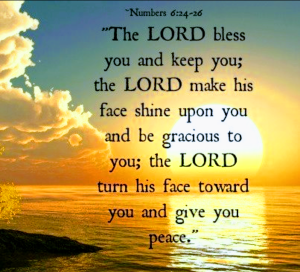
May God bless and keep you. May God’s face shine upon you and give you peace.
For SO MANY YEARS, my life was out of control, and my brokenness held a death grip on the teeniest desire I may have had to change. During that time, if anyone would have told me to be grateful, I likely would have side-eyed them while restraining myself from doing them great bodily harm! (Don’t laugh! I still have my green belt in karate from thirty years ago that never expires! Yeah, that’s right, I can be dangerous!) So anyway, in their stunned state, while I had their attention, I would have pulled out my handy “gratitude – NOT” list and spewed all my anger and bitterness right at them.
Let’s see…
Thanks, mom, for all the abuse. That was fun.
Thanks, psycho-neighbor kid, for introducing me to perversion when I was too small and afraid to run away from you. Oh yeah, and for breaking my nose with a 2×4 (not kidding).
Thanks, ex-husband, for your “lying, cheating, cold dead-beating, two-timing, double-dealing, mean mistreating, (un)loving heart”. What a knight in shining armor you turned out to be!
Thank you, world, for gleefully providing all my trivial wants, empty longings, and self-centered demands.
Oh yeah, and thank you, God, for totally ignoring all the above.
I was bitter and hateful all those years, entrenched in such a deep sense of emptiness and hopelessness that I felt the only relief from the pain was to end my life, and I made a failed attempt at that when I was twenty-three (Okay, I’ll thank you now for that, Lord). Two years later, when I married my current husband, Tom, I became a Christian. But, for years, it was in name only, and nothing really changed. Like “putting lipstick on a pig,” as they say.
Though that was the beginning of my faith journey, it took years of healing for me to warm up to this scripture verse that is most critical for a life to be filled with joy and passion and purpose: 1 Thessalonians 5:18, “Be thankful in allcircumstances, for this is God’s will for you who belong to Christ Jesus”.
It has only been in the past twenty years or so that I have been able to truly grasp and claim for myself the meaning and depth of gratitude in two significant areas of my life that kept me trapped: the painful experiences of my past and my sense of entitlement. I was always striving for “things”, successes, whatever it took to numb the pain. Constant shame battled with my pretense of being emotionally stable and spiritually healthy, “Look at me, people! Aren’t you jealous? You are, and you know it!”
I know gratitude for the pain as well as the joys in life seems like a paradox – it makes no sense at all, right? Believe me, I get it. The pain inflicted by others left me empty of purpose and hope. I had no concern for anything or anyone beyond myself. But gratitude loosened my white-knuckled grip on all that hurt and my own sins as well, which was actually my biggest hurdle. I suppose that’s why it got stuck at the end of the line while screaming for my attention.
The beginning of my transformation was like the forest and trees analogy: I had to step away and look back to realize how God was with me all along, that he did love me, and had a plan to use my pain in service to others. My gift was to share my story. My purpose was and still is, to walk alongside those God puts in my life that are also broken and lost. I owe a debt I cannot pay to a God who will never send bill collectors to my door – not ever!
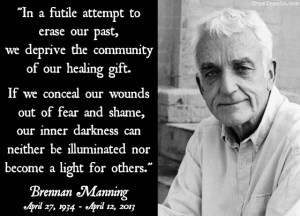
My life has never been richer. I have never been happier. Beginning with the discovery that anything the world has to offer could never fill the void or heal my wounds. As Brennan Manning tells us:
So is my life pain and heartache free because I shop the sale racks now? No…but…now I know how to access God’s love which resides within my very being; I know I can hope and trust in him to overcome anything life throws my way, even if I may not have the slightest idea what good will come of those struggles.
Sooooo, how do you replace discontent with gratitude? Is gratitude a simple act of the will?
It’s important to first realize what we’re up against. I believe the biggest obstacle to gratitude and contentment is our Western culture’s sense of scarcity in all areas of life. We need more gadgets, a bigger house, a better car, a more important job to be happy.
We’re always comparing – because someone else has more and they look happier. The Scarcity Gremlin eats up sufficiency for a midnight snack. So, each day begins with a sense of “not enough” of___________ (fill in the blank) and then a striving to get it. Whatever “it” is.
How can you be content, you ask, when your new neighbor, who just moved into a house twice the size of yours, is younger, prettier, has a career you envy, and a pool to die for? And if all that wasn’t bad enough, she speaks eight languages – you only speak four. She has traveled to fifty-two countries – you have only made it to thirty-eight. She’s been married six times – you’ve only been married once! Okay…ENOUGH! It’s endless and exacerbating. And, guess what? Even the wealthy we envy are suffering, especially the kids who are paying the price.
Our sense of scarcity, our need to one-up others, distorts and devalues all the blessings and gifts we have been given. We are so hyperfocused on what we don’t have we fail to appreciate or show gratitude for what we do have. Gratitude seems to be a lost virtue.
According to a CNN article, “Suniya Luthar, a professor of psychology, has been studying the lives of privileged children for 25 years. Her research has shown that drug and alcohol use among affluent teens is higher than among kids of the same age group in inner cities. Further, children growing up in wealthier households are more likely to be suffering from anxiety and depression compared with the national average, according to the research.”
David G. Myers, the author of The American Paradox: Spiritual Hunger in an Age of Plenty, wrote in an American Psychologist article. “Compared with their grandparents, today’s young adults have grown up with much more affluence, slightly less happiness, and much greater risk of depression and assorted social pathology. Our becoming much better off over the last four decades has not been accompanied by one iota of increased subjective well-being.”
You know you want to change because there is something deep within your heart that has been relentlessly pursuing you for a very long time. Annoyingly reminding you how discontented and unfulfilled you are with your life and with all your “stuff”. You need to trust that God is just waiting for the slightest motion toward him. That mustard seed step of faith (Matthew 17:20). A faith that begins with patience and hope, which are two critical elements of a healing heart:
Gratitude requires a great deal of patience and trust in God’s timing and ultimate plan for our lives.
(iStock image)
Hope is not tangible; it is in things unseen: “Now faith is confidence in what we hope for and assurance about what we do not see.” Hebrews 11:1
Dr. Robert Emmons of the University of California-Davis, considered the world’s leading expert on gratitude, says, “Gratefulness is a knowing awareness that we are the recipients of goodness.” When we turn our focus from ourselves to God, we are the ones who benefit. “The self,” in the words of Emmons, “is a very poor place to find happiness or meaning in life.”
“Every good gift and every perfect gift is from above (not Amazon prime), and cometh down from the Father of lights.” (James 1:17)
Now then, time for more true confessions. Until six weeks ago, I felt pretty altruistic and benevolent toward “the least of these”. After all, over the years, I have given away perfectly good: designer clothes, furniture, household items, a kidney, canned goods, and my precious time and energy. I thought I knew what poverty and hopelessness were all about. I was wrong.
My husband and I went to Rwanda in Central Africa to visit our son (who’s in the military), daughter-in-law, and two of our grandkids. It has been one of my most profound and overwhelming experiences! Here, hunger has stared down my apathy. I have seen the memorials that display the graphic reality of the genocide in 1994: A mass slaughter of almost a million men, women, and children in just one hundred days, by their own neighbors, while the world stood by and watched. I have talked to survivors and been surrounded by hungry and shoeless children. I can’t even describe how it has torn at my heart.
When I think of the contrast between Rwanda and America: what we have and they don’t, what they appreciate and we don’t, I can’t help but think about the virtue of gratitude. When we left there, I prayed that I would be a different person when I returned home. That I wouldn’t forget. I prayed that contentment would look much different. That I would be mindful of the difference between need and want, and I would not be so wasteful or take anything for granted again. Since then, I have been a mix of getting it right and getting it terribly wrong. But I keep trying.
Just try to imagine the following contrasts. I hope these will give you a sense of how this experience has impacted me:
In January 1994, my mother died of heart disease. Eight months later, my father died of cancer. Because they hadn’t belonged to a church, a minister was provided by the funeral parlor.
Before my mother’s wake, the minister gathered all twenty grandkids and great-grandkids. He asked us to tell him something about this woman he’d be eulogizing the next day. He wanted to relate some happy memories of my mother at her funeral.
In complete silence, we looked at each other, incredulous, thinking, “Come on, somebody. Come up with something!” Digging into the recesses of our memories, we slogged through the anger and sorrow. Trying desperately to recall a long-forgotten quip or enlightening conversation, maybe a silly habit, a favorite joke, one particular Christmas tradition, or what about that time when…?
Nothing.
At the end of my mother’s life, her family had nothing to say about her. Well, nothing you would say at a funeral. You think it, but you don’t say it. Seeing that there’d be no wealth of joyful material from which to draw his comments, the minister politely excused himself to hunt up some old familiar one-size-fits-all sermon. That experience left me numb.
My father’s death was like suffering through a bad movie for the second time: The same cast of characters, the same setting, and faulty plot line. But, again, the twenty of us couldn’t come up with a thing; even though my dad wasn’t mean, he wasn’t there for us either. The silence was deafening – and I was angry. I wanted to shout, “How could the two of you do this? How could you inhabit this earth for over seventy years, at the epicenter of a family you were supposed to love, and not leave behind even the faintest happy memory?”
I hadn’t expected this level of grief. I didn’t understand it. How could I grieve for the parents who had left me nothing to miss? Eventually, though, I realized that I was grieving the absence of love. I longed for my parents’ love all my life, but I had just been fooling myself. And now…that longing would remain unfulfilled.
Those two funerals, and my indignant response to them, proved pivotal to the changes in my life that would follow. I was inspired to set two goals: To seek the love that would draw me closer to God and to share that love with others, especially my family.
My Turn
I hoped I’d have a different funeral, a different legacy than my parents. I wanted to be remembered as someone who had loved, had honestly and openly confessed to others when I’d failed or fallen short, and had needed and known God’s mercy. And I wanted everyone who attended my funeral to have a smile on their face! – a smile that reflected the joy we’d shared, the compassion we’d known, the forgiveness we’d received, and the love we never doubted.
As scripture tells us, “…if you have faith as a mustard seed, you will say to this mountain, ‘Move from here to there,’ and it will move, and nothing will be impossible for you.” (Matthew 17:20)
After determining my two goals and reviewing my life accordingly, I could see that a mountain would indeed have to be moved. And, in all honesty, I also felt that it might be impossible! Did I even have the strength of character to become the person I envisioned?
Your Turn?
That was over twenty years ago, and I can tell you with absolute conviction that it is not only NOT impossible, but it is God’s promise to us and will be fulfilled by him! He simply needs our mustard seed of faith, shaky knees, sweaty palms, and trepid “okay, I’ll give it a try” response. The result is not ours to know. However, it is God’s already set-in-place plan if we’re willing to cooperate with him – and trust.
Perhaps, unlike everyone else in all creation, you are privy to the date and time of your demise. But, even then, you may or may not have LOTS of time to fix all the messes you have made in your life and the lives of everyone around you. Otherwise, procrastinating on this one is probably not a good idea.
I’ll leave you with this fun little bit of wisdom from Gian Carlo Menotti, “Hell begins on the day when God grants us a clear vision of all that we might have achieved, of all the gifts which we have wasted, of all that we might have done which we did not do.”
The prelude to Easter is a most blessed time for Christians. We are now experiencing what is to come and called to reflect on Jesus’ life, death, and resurrection as they relate to our lives today. The sad reality is that we often get stuck with the Good Friday Jesus. If we allow that to happen, then Jesus becomes just another prophet, albeit a pretty good one. Love those parables!
Don’t get me wrong, I’m not knocking the prophets. On the contrary, I find encouragement in their messed up, bumbling, curmudgeonly, can’t-get-their-shit-together, parts. High five there, Jeremiah! But then, if we fail to consider the resurrection, God remains remote and irrelevant to our lives. Truth be told, that’s probably why we anchor ourselves at the tomb.
Do you suppose God just dropped Jesus off here and left him to fend for himself? If so, then why would I depend on him? I’ll get my card punched on Sunday, but I’ll just take care of myself in my day-to-day life. Thank you very much. I’ll come back to why that doesn’t work in a moment, but for now, let us consider these passages:
“All who see me mock me; they hurl insults, shaking their heads. ‘He trusts in the LORD,’ they say, ‘let the LORD rescue him. Let him deliver him, since he delights in him.’” Psalm 22:7-8
“My God, my God. Why have you forsaken me?” Matthew 27:46
Those who hated Jesus so bitterly stood at the foot of the cross and scoffed at him, “Where’s this God of yours now? He doesn’t seem to be bothered about you”! Keep in mind that the belief of the Jewish people was based on punishment and reward. They were saying, in essence, “See, we are justified in crucifying you, Jesus, and God’s silence is proof of it. It was your own blasphemous sins that brought you to this end.”
There were lots of people standing near the cross that day: those who hated Jesus, those who loved him, and many others who did not know what to think about him. Everyone was waiting to see if God would show up. But he was silent, even when Jesus cried out to him. It was a justifying silence for Jesus’ accusers and murderers, a deafening silence for his followers, and a confusing silence for those who just weren’t sure.
Those who believed in Jesus, who put all their faith in him, were desperate for God to rescue them. They were hoping for retribution. So imagine how devastated they must have been when God was silent, and Jesus indeed died. As they walked away, their weariness was more than they could bear – hopes morphing into despair – mumbling under their breath, “Why didn’t you come, Lord? Why didn’t you save him? What are we to do now? If this Jesus was not the One, who then? How much more can we take”?
Sadly, for many of us, faith is based on the same idea of reward and punishment. Think you’re going to heaven? Think again if you’re bad! (However you define bad.) Think you’re going to hell? Who knows? It’s a lifelong nail-biter, isn’t it? God as the proverbial Record Keeper, added to that the concept of a God out in the stratosphere, distant and aloof, and it’s no wonder we feel lost in this crazy world.
Ponder for a moment, if you will, how the above passages speak to your own life. That’s all I’ve been thinking about lately. Growing up, my family was of no faith. I only recall going to church once with them, though a neighbor regularly took me to Sunday school. That one Easter Sunday, we all had new outfits, paraded into my grandmother’s church, and paraded right back out.
I had no sense that God was there when my mother was physically abusive, or when I was being sexually abused, or when I was twenty-three and tried to commit suicide. He wasn’t there when I regularly drank myself into oblivion or for too many other “got the T-shirt for that one” events in my life.
All of this pondering begs the question: Is God present to us or not? Does he care one lick about our day-to-day lives? Did he just dump us off here too? “There you go, Linda. Have a nice life. See you at the end – maybe – or not.”
We will never have the answers to our most profound questions if we remain stuck with the Good Friday Jesus. We must live our faith from the other side of the resurrection! That is the only place it is possible to view God’s immense love for us. Jesus’ life, death, and resurrection point the way. In the moments that it feels like God is silent in our suffering, there is a reason far beyond what we can humanly understand. It is not God who is not present to us; it is us not present to him. Have you ever considered that? God is totally invested in every one of us!
If you feel distant from him, it may be a good time to look at where you are in your faith. For me, those moments have always pointed to my being too caught up in things of this world to give God much thought. And truth be told, often, it is intentional because Iknow I am not where he wants me to be, and I don’t want to change. So there – I said it.
I can often be selfish and self-serving, and there is no room for God there. And then I get whacked with this passage, “For the Lord your God is a consuming fire, a jealous God.” (Deuteronomy 4:24) How can I possibly enjoy my worldly pursuits when he’s watching – fuming perhaps? La la la la la – I can’t hear you! (I don’t recommend that – it has never worked well for me.)
(Gipsy)
My beloved friends in Christ, this is when we are compelled to open the eyes of our hearts! There are two passages in scripture I would offer you for your reflection as we near this blessed time of Jesus’ Passion:
Luke 19:41, “Now as He drew near, He saw the city andweptover it….” When the crowds saw Jesus entering Jerusalem, they began singing praises.”
Why did he weep? Likely because he knew they still did not understand. They followed, praised, and put all their hopes in an earthly King. Jesus’ heart ached because God loved them so deeply that he was preparing to die for them, yet they could not comprehend the magnitude of that Love.
Matthew 27:50-54, “And Jesus cried out again with a loud voice, and yielded up His spirit. Then, behold, the veil of the temple was torn in two from top to bottom; and the earth quaked, and the rocks were split, and the graves were opened….So when the centurion and those with him, who were guarding Jesus, saw the earthquake and the things that had happened, they feared greatly, saying, “Truly this was the Son of God.”
Do you see? God’s heart was torn apart for the love of his Son. Do you know why he was willing to suffer such pain? Because his heartachesfor the love of you and me as well! He longs for you to come out of hiding and step into his light!






























 PASSION, PURPOSE & POOPYHEADS