Imagining a Woman President: Lessons from St. Catherine of Siena

The 2028 Presidential election is looming large. It’s just two years away, and it can’t come soon enough. I am hoping and praying that enough Americans have learned a tough lesson about the sacredness of our democracy that thousands of men and women died to protect, and we will self-correct at the ballot box. To that end, I would like to throw my whole-hearted support behind…drum roll please…
St. Catherine of Siena!

And I think she’s ready. You see that look? That’s the look of, “What the hell were you thinking?”
She sees what the men in power have done to this country, and she’s no stranger to the narcissistic and patriarchal mess they have made! After all, with Jesus’ prompting, she called out two evil Popes and didn’t stop there. When she saw corruption among church leaders and bishops, she called them out, without fear or hesitation.


But she wasn’t always fearless. As a matter of fact, she felt the same as all women of her time (1347-1380). One of her earliest biographers, Raymond of Capua, shared her words after she received a vision from Jesus in which He called her to instruct the “learned men” of her time:

“How can I be of any use in the work of saving souls,” she asked the Christ who called her in visions, “for I am a woman, and it is not seemly for my sex to try to teach men, or even to speak with them. Besides, they take no notice of what we say.” …


It was the Jesus of her vision who responded: All things are possible for God who has created everything from nothing. I know that you say this with humility, but you must know that in these days pride has grown monstrously among men, and chiefly among those who are learned and think they understand everything…. I have chosen unschooled women, fearful and weak by nature, but trained by Me in the knowledge of the divine, so that they may put vanity and pride to shame.…”

Catherine may no longer be available. Still, I’ll bet there is a perfect reincarnation of her right here, right now: a woman of her stature and prominence who can run this country with honor and integrity. Who can reestablish our connection with the countries that have rejected us on a grand scale. Who can bring hope to our youth who desparately need it right now. Who can restore the lives of so many immigrants and minorities who are just as valued and loved by God as everyone else. Let’s make this happen!

I will leave you with a few of my favorite quotes from some amazing women:


“Women, if the soul of the nation is to be saved, I believe you must become its soul.” Coretta Scott King


“None of us can know what we are capable of until we are tested.”
– Elizabeth Blackwell, first woman to graduate from medical school in the U.S.


“A leader takes people where they want to go. A great leader takes people where they don’t necessarily want to go, but ought to be.”
– Rosalynn Carter


“There are two kinds of people, those who do the work and those who take the credit. Try to be in the first group; there is less competition there.”
Indira Gandhi

I even have a theme song for this campaign: https://www.youtube.com/watch?v=rptW7zOPX2E

And we probably should have T-shirts:

About

  1. I am a beloved sinner.
  2. A recent widow, mom, grand-mom & great-grand-mom.
  3. In Covid limbo. Not even sure what that means.
  4. I have made an untold number of missteps in my seventy-three years, and, please God, a suitable number of corrections. Sometimes, with a straight face, I profess to know everything. Most times, while laughing at myself hysterically, I admit to knowing nothing. 
  5. While I use the term loosely, I have authored a book, Why Surrender is NOT a Four-Letter Word. Though I think there is an unwritten law that at least one other person, possessing some bit of authority (not your mother) knights you “Author” and, maybe, pays you for your work. Anyway, I fancy myself a writer. You can decide for yourself. If you would like to read more about my book and information regarding a copy, go here.

My blog is comprised of ongoing writings that have been inspired by something God has revealed to me, usually in my day-to-day screw-ups, and sometimes awesome stuff that didn’t hurt! All blessings too incredible to keep to myself.

Also, I’m sure you’re dying to know this – so, yes, God talks to me. But not in that “still small voice” some people experience. It’s more like the whack of a 2×4. And believe me, when that happens to you often enough, you learn to catch yourself screwing up! It makes life a little easier with fewer lumps!

I’m so glad you stopped by, and I hope you enjoy my ramblings. Come visit anytime!

This page was updated 2/02/2022

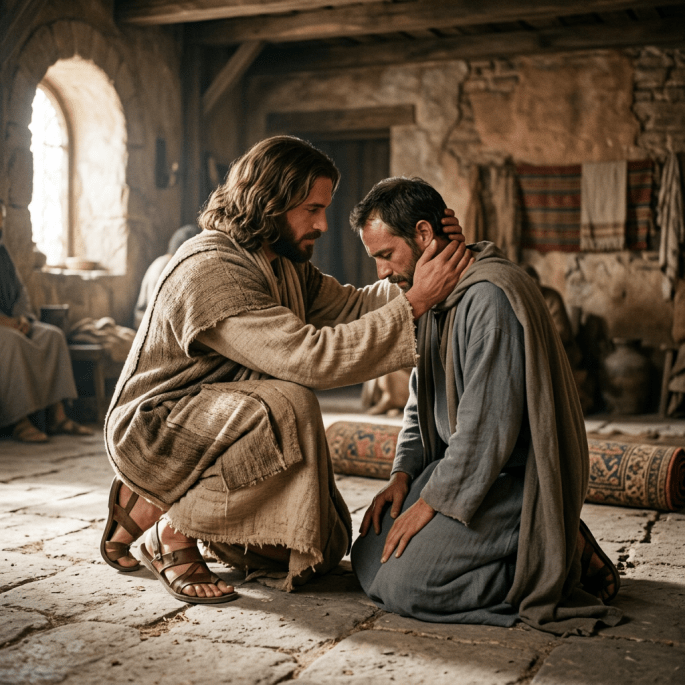
Two men in ancient robes in an emotional comforting gesture inside a rustic room

When the Good Samaritan Ends Up in the Ditch

In Matthew’s Gospel (22:35-40), this rich lawyer is trying to make his way into heaven with the least effort and responsibility. First, he asks Jesus what the greatest commandment is, already feeling confident that he adhered to all the “laws”. Well, okay, there was that one tiny indiscretion when he kicked at an annoying beggar on his way to the Temple one Sunday. But, geeezzz, he didn’t kill him!

I can see Jesus looking at him side-eyed as he tells him the greatest commandment is to love God completely and your neighbor without exception. Nothing ambiguous about that.Right? Except the lawyer immediately asked for specifics: “Just so I’m clear, define ‘neighbor’.” So now he gets Jesus’ famous eye roll, which is always followed by one of his favorites, The Good Samaritan (Luke 10:25-27).

We all know this one, but here’s what many people don’t realize that makes it so profound: The man who was beaten up was Jewish. The Jews and Samaritans were sworn enemies, and that went back for centuries, long before Jesus’ time. Yet it wasn’t the Priest or the Levite who stopped to help him. They went out of their way to avoid him. It was the Samaritan who didn’t give it a second thought. A man needed help. Period.

So many of us today try to bargain with God when we don’t like what he says. Or we interpret Scripture in a way that’s convenient for us, “So, God, you really didn’t mean I have to love everybody! Right? I mean, there are lots of people who are just, well, unlovable. I can think of one right now who is destroying our country. Lots of people agree he’s a terrible person (not naming names here). Surely, you don’t like him, let alone love him! Right? Right?”

Crickets…as God gives you that side-eyed look. Again!

Father Richard Rohr tells us, “Religious people who use the Scriptures to condemn or exclude others seem to have different goals and objectives from those of God or Jesus. Their arguments generally have to do with very secular concerns: power and control, fear of the other and the unknown…. Check the Gospels if you don’t believe me.”

So, I’m asking you what part of the command to love don’t you understand, like, or follow? Then, ask yourself, am I the helper or the guy in the ditch? Things can look much different there. At times throughout life, we may all be the helper, but more often we find ourselves right alongside so many others in that ditch while people pass by on the other side of the street. Please, don’t be that person. Yes, it’s risky. You have no idea what they might do in response.

We don’t know for sure if Jesus always knew the price he would pay for caring for the guy in the ditch. But, he did it anyway. And, yes, he did pay the ultimate price for doing it. What price are you willing to pay? What risks are you willing to take if you profess to being a follower of Christ? Being a “Christian” in name only is certainly easier and safer, but is it what we are called to in the midst of all the suffering that surrounds us today? I think not.

Don’t think for a moment there weren’t times when I worked with the homeless that I didn’t wonder what the hell I was doing. Like the time I found a couple who had called us for help. They were sleeping in the woods and hadn’t eaten for days. I put them in my car and drove them to a shelter. Later, I brought them food and listened to their story. He had been in and out of jail for years and had been abandoned by his family. I hugged him. Then, this big, tough-looking guy you would have crossed the street to avoid began to cry because no one had ever hugged him or made him feel worthwhile.

At times in this life, we will be called to be the helper; other times, we will be that guy in the ditch. I have been that person more times than I can count. I will never forget those helpers God sent me during the worst times in my life. How about you? Perhaps now is the time to pay that forward.

Rewriting Eve’s Story: Divine Fairness, and Finding God in Unjust Times

Did you know that Eve spent three years in therapy? No, you didn’t, because that fact was erased from our history along with so many others that just didn’t fit the criteria of the authors of Scripture.

Oh, don’t get me started! – Too late!

I believe it’s very telling that a lot of the missing facts in Scripture just happen to be about women. In particular, strong, powerful women who had something important to say about God’s call in their lives.

Okay, I got way off track. But, if you want to read more about it, I highly recommend the writings of Dr. Bart Ehrman, “The books removed from the Bible, whether from the Old Testament Apocrypha or early Christian writings, reveal a dynamic and evolving process driven by theological debates, questions of authenticity, and the shifting needs of early Jewish and Christian communities. Excluded texts, however, continue to offer valuable insights into the religious and cultural context of their times. While they may not have made the final cut into the canon, their existence highlights the diversity of beliefs and practices that characterized early Christianity”.

Anyway, back to Eve’s therapy sessions. If you recall, Adam, metaphorically being caught with his pants (or more accurately, his fig leaf) down, pointed his finger at Eve, “It was her fault, God! She made me eat the apple. I don’t even like apples!”  Oh, and you think Eve wasn’t pissed? She, and every woman bearing children after her would have to endure the pains of childbirth. How is that fair?

So, after Eve suffered at least four times in childbirth while Adam sat in the waiting room watching a football game, she had had enough. When she was able to pull herself together, she made an appointment with a therapist. She was done! But, it didn’t go well in therapy either because at every session she cried uncontrollably, “IT’S NOT FAIR! God believed Adam when he blamed me for that whole apple incident while he snickered behind that damn tree?! IT’S NOT FAIR!!!”

After six sessions with her and nothing being resolved, the therapist sent her away with a copy of the forthcoming book, “When Bad Things Happen to Good People”, by Harold Kushner. Since it would be a LONG TIME before the book came out, the therapist gave her a synopsis, which I will share with you in a moment. But first, let’s get serious…

How many of us today are horrified and angry with God for all the terrible things we are seeing on the news or are experiencing ourselves: the hatred, abuse of innocent people, children going hungry, immigrants detained in detention centers under deplorable conditions, a failing economy, and a war out of control? Of course, all that invokes anger and fear. But have we concluded that God doesn’t care because He won’t answer our prayers, or worse, that He has caused all of this turmoil to punish us for some reason?

I have to say that today I am in a better place to deal with all of this emotionally because I did my fist shaking at God years ago at one of the worst times in my life, which I wrote about in my book. During that time, I turned away from God because I was certain He didn’t care about what I was going through, and I told Him so. I felt so lost and angry that I struck out at Him, “If you cared so much about me, where were you when my mother was abusing me and when I was sexually abused by my brother-in-law?!” And then, suddenly, I heard Him speak to my heart so clearly, “I was right there with you. Your tears were my tears. Because I have given you all free will, I cannot control your actions, which breaks my heart. But, Linda, you too have sinned and fallen short.” OOPS!

So, now let’s consider these words from Harold Kushner. Who wrote his book after the death of his son:

“Life is not fair. The wrong people get sick, and the wrong people get robbed, and the wrong people get killed in wars and in accidents. Some people see life’s unfairness and decide, ‘There is no God; the world is nothing but chaos.’ Others see the same unfairness and ask themselves, ‘Where do I get my sense of what is fair and what is unfair? Where do I get my sense of outrage and indignation, my instinctive response of sympathy when I read in the paper about a total stranger who has been hurt by life? Don’t I get these things from God? Doesn’t He plant in me a little bit of His own divine outrage at injustice and oppression….Our responding to life’s unfairness with sympathy and with righteous indignation, God’s compassion and God’s anger working through us, may be the surest proof of all of God’s reality.”

So, never forget, God has given us His heart of compassion and empathy for others who suffer unrighteousness. And, yes, we are justified in the anger we feel. However, shaking our fist behind locked doors is not the answer. When we do that and insist that God fix it, his response, if we’re listening, is, “That’s what I have created you for, to be my hands and feet in this broken world. How will anyone know my love for them if you don’t show them?”

Lent and Forgiveness: Breaking the Cycle of Anger

I would like to lodge a complaint with the Universe – IT’S NOT FAIR! I suppose I should have waited until Lent was over. After all, we are told to believe that Lent is a time to give up things like – IDK – anger. It’s a time for repentance of things like – anger. A time to control things like, yep – anger! And I do that perfectly for at least the first thirty seconds after I wake up on Ash Wednesday.

You see, I, for one, feel a need to repeat my hurts, over and over and over, until someone, somewhere acknowledges them and apologizes. I want others to pay for their sinfulness against me and beg for forgiveness. Maybe pay for a billboard that announces to the world what a dreadful, monstrous, appalling, very bad human they are. Then, I will consider forgiving them. Maybe. But then I keep a list of offenders that I update regularly and offer to God, lest he forget.

Another aspect of clinging to our anger is the possibility that we will pass it on to our children, unwittingly. I witnessed that during the year my husband and I spent in Belfast, Northern Ireland. I had the opportunity to meet a therapist who worked with kids in gangs there. The Troubles were supposed to have ended with a Peace Accord in 1994. But some people could not let go of their hatred. The teens were also divided between Protestants and Catholics, just as their parents were before. The kids who were trying to reconcile with each other were often admonished by their parents, who could never forgive.

So I sit stubbornly at the tomb, imagining that Jesus and I are members of this whiners’ club of those who have been mistreated. Not realizing the tomb is empty, Jesus is long gone, and so is everyone else who has moved on to the hallelujah and baked ham part of the Easter story.

I guess I need to reimage Lent as a time of giving up anger instead of the easier choice: chocolate, and work toward forgiveness instead of toughing it out until I can eat chocolate on day forty-one (IF I manage to wait that long), when I can celebrate my endurance with a giant Hershey bar and my ego still intact.

I know, forgiveness, YUCK! It feels unfair. We don’t want to let others off the hook. What we fail to realize is how Anne Lamott beautifully described unforgiveness: “Unforgiveness is like taking rat poison and waiting for the rat to die.” Our hatred and anger cause us to suffer, while that other person probably couldn’t care one whit.

Maybe Lent isn’t about successfully avoiding anger. Maybe it’s about noticing it…and deciding to forgive anyway. Maybe it’s meant to soften the way we hold on to our hurt, to acknowledge the other’s humanity and dignity. While we may give someone a second chance to grovel at our feet, Jesus quit counting way after seventy times seven, and he wants us to do the same.

And, finally, as Nadia Bolz-Weber says, “maybe you’re just not that special. Maybe you are just like me and everyone else: part asshole, part angel.”

Finding Faith Amid Uncertainty: A Lenten Reflection

The Lord gives us eyes to see, really see, if (BIG IF) we are willing, open, and present to him. Perhaps this season of Lent will be an opportunity for us to pay attention to what God is doing in the midst of what is frightening us as a nation and as individuals.

For too long, this country has cast God aside in favor of our own wants and desires, rather than concern for others. Things we thought were so important may now be hindering our ability to survive what we’re facing today: so much anger, violence, and uncertainty.

We are in the midst of Lent, yet the empty pews in churches of every faith are a stark reminder that we may have lost the very ground of our being. Perhaps this is the perfect time to find our way back to God – lest we forget how much he sacrificed for us.

How are we actually living our new reality? The answer runs the full spectrum between those who are frightened and immovable, to many who seem to be indifferent, to those who are fighting back.

Yes, these are, and will probably continue to be, trying times as we suffer the physical, emotional, spiritual, and economic impact unlike anything we have ever known. But, hold on…don’t leave me for a stiff drink yet! I have GOOD NEWS. Really!

Here we are experiencing so much uncertainty right in the midst of the most holy season of Lent. We have no idea what the outcome will be, but we do know how the Passion of Christ plays out. So, let me ask you a question: what has the life, death, and resurrection of Jesus meant to you up until now? To make this work, you have to be brutally honest. Okay?

Many faiths observe various practices during Lent. Some have requirements or suggestions for observing this season: fasting and abstinence, unless you’re old like me. We are encouraged to attend services, pray, read scripture, and share our abundance with the poor. Maybe throwing in a confession somewhere if you’re so inclined and riddled with guilt.

We are called, just as his disciples were, to surrender our self-will just as Jesus did when he prayed, “Father, if you are willing, take this cup from me; yet not my will, but yours be done.” (Luke 22:42). And “If anyone wishes to come after me, let him deny himself and take up his cross and follow me” (Matt 16:24).

So, let’s take an honest look at our individual observances of Lent, shall we? I’ll go first:

 • I used to love fish fries when I was still a beer drinker and less concerned about recycled hydrogenated oil – YUCK!
• I do Intermittent Fasting for my health regularly, but my “spiritual” fasting practices are, honestly, pathetic. Okay – non-existent.
 • Going to Church always felt like a requirement to have my card punched once a week. Sort of like getting that sticker we flash around to impress others, “I voted” or “I Gave Blood”.

I gave up my ambition of being Saint Linda and began to give myself to God for His purpose, even though I had no idea what that purpose was. He seemed a bit wiser than I always imagined myself to be.

Okay, guys, I’m standing here with my sins exposed. It’s your turn. Don’t worry, no one’s going to call you out. You don’t have to expose yourself to judgment like I just did. Just take a quiet moment to think about it, and then we’ll move on. Go ahead, I’ll wait right here.

Okay, so Pope Francis offered some powerful words to consider during Lent: “Jesus’ Pasch is not a past event; rather, through the power of the Holy Spirit it is ever present, enabling us to see and touch with faith the flesh of Christ in those who suffer.”

And there it is.

God has been making this call to us since Jesus walked the earth; the call to get off our butts and care for the poor and suffering among us. Jesus was here in the flesh to show us how that should be done. And how do we respond today? Many heed that call, some half-heartedly drop coins in a beggar’s hat, while others simply aren’t listening. Not much has changed in two-thousand-some-odd years, I suppose.

So, let’s consider the three phases of Jesus’ Passion: His life, death, and resurrection, in light of our call to imitate him:

 • His life: Of his thirty-three years here (give or take a few), on the surface, it appears that only the last three were spent
fulfilling his purpose. Three years. That’s it. I’m seventy-seven and hate to admit how many years I have wasted. But Jesus wasn’t wasting his life. He was growing into his purpose.

When I look back on my life: all the mistakes and missteps, the hurt inflicted on me and by me, the selfishness and rejection, there would have been no way for me to be all God created me to be because I didn’t even know who that was. But, I do now! I don’t know how much time I have left here. But it doesn’t matter because time has no meaning for God, so it shouldn’t for us either. Each day is a new opportunity to bring Christ to our suffering brothers and sisters. And it isn’t just a privilege; it’s a responsibility we all have.

 • His death: Jesus knew that his constant presence was a threat to the status quo. He knew that every choice he made to expose the rich and powerful would risk his very life. He didn’t hold back from calling them out with choice words to describe them, even though it surely sealed his fate: “Hypocrites, brood of vipers, prideful, whitewashed tombs, legalists disguising an inner corruption. They preach, but do not practice” (Matt. 23). His death was inevitable.

Most of us will not be called to sacrifice our lives, but we are all called to die to our self-will so that God can use us in whatever way he has already predetermined. That might mean having the courage to step into what may be uncomfortable, probably risky, perhaps even scary. But expect it to be a wild adventure because God doesn’t do ordinary! You know that. Right?

 • His resurrection: When Jesus died, everyone believed they would be returning to their ordinary, mundane lives. Alrighty then, that was a wild and crazy ride! We could liken it to that special vacation we always dreamed about and finally got to experience. The difference is that we probably have pictures to reminisce over; they got nothing, not even a stinkin’ T-shirt to commemorate their time with him.

And for us? Resurrection does not mean a new birth, but a “rebirth”. It means returning to our original holiness. Before we were born, God created us with Love, for Love. Saying “yes” to God means saying “yes” to our true selves and “no” to the lies we have believed about our unworthiness.

Jesus’ Passion was a seeming disaster turned triumph. The conventional thinking of our time is that we can’t handle tragedy and suffering; that we will fall apart and resort to some primal survival instinct. I choose to look instead at the myriad examples of people around the world who are showing love, compassion, and hope. And out of the ashes of disaster comes the gift of the blessedness and fullness of our humanity. Yes, you and I are our brother’s keeper! It’s in our DNA.

This, my dear friends, can be a turning point in what we believe about ourselves and our neighbor, and in what we are capable of in the face of fear and uncertainty, if we trust in the divinity of our very souls, where God resides and where we live and move and have our being. What you believe right now will determine how you act. So, believe and act as if you and everyone around you, friend or stranger, are beloved and precious children of God.

In our new reality, we need to do away with “practicing” our faith and get to the business of “doing”.As I write these words, I fully understand that none of us has any idea how this turmoil in our country will turn out. But, I do know this – God does not cause such chaos. So get that idea out of your head. But he will use it for good!

I love this quote by Rebecca Solnit, “Disaster could be called a crash course in Buddhist principles of compassion for all beings, of nonattachment, of abandoning the illusion of one’s sense of separateness, of being fully present, and of fearlessness…in the face of uncertainty.”

My prayer is that we will take on that mantle of courage and faith now, whatever that looks like, wherever we are.

May God bless and keep you.

May God’s face shine upon you and give you peace.

Reimagining Christianity: Love Over Doctrine

This is a huge moment for me. I have come to the decision that has been in process since 2010. That was when I walked away from the “Institutional” Church. In these ensuing years, I have moved from the Church to the desert, back to the Church, back out into the desert – round and round. Why?

Let’s take a quick stroll back in time. Here is a condensed version of why I’m struggling with “Christianity” as it is today. Jesus shows up and spends three years teaching his followers, by his example, about God’s love for “everyone” – no exceptions.

Fr. Greg Boyle tells us, “In the early years, Christianity was a subversive spiritual movement of equality, emancipation, and peace. It was a way of life, not a set of beliefs.” Jesus’ followers didn’t “go to church”, they were church – the living, breathing essence of God’s love and care for humanity. And for that, they were persecuted, and some were killed.

Then, three hundred years later, along came Constantine, who turned Christianity into an Imperial religion within an Institutional Church and demanded loyalty to him. Rules and dogmas were established along with a long list of things you must believe to get your sorry butt into heaven. Following in Jesus’ footsteps became “religion”, something the early Christians would never have recognized.

Father Boyle, in his beautiful book, “Cherished Belonging”, says, “A great many mystics criticized the Church for losing track of the centrality of love, a failure that indeed seduced the Church to embrace empire and control as its centerpiece. We forgot to do love’s work.”

So, let me ask you, is this the “church” we see today? Is a vengeful, demanding god the one you have bought into? Does a spiteful god make you all warm inside and make you want to emulate him? Does this god make you want to be a better person, love your neighbor, and strive to make the world a better place? Or does this god make you want to kick the dog, curse your obnoxious neighbor, and roll your window up at the stop sign and glare at the homeless guy standing there?

Do you walk out of that confessional all cleansed and forgiven and stare in judgment at the guy standing behind you because you assume his sins are much worse – like mortal – like going-to-hell, mortal?! The same guy who wouldn’t buy one stinkin’ box of Girl Scout cookies from your daughter. Never mind that he’s a diabetic on insulin and had to have four toes amputated last year.

How are we doing so far? Paints a lovely picture, doesn’t it? Sadly, this is the god I learned to fear when I first became a “Christian”.And I thought I was a perfect Christian. But you, on the other hand, well, you were clearly lost and needed correction, which I was willing to offer, lest you end up in hell.

Excuse me a minute while I try to control my laughter. Ok, sorry, I’m back.

Jesus didn’t call us to a “belief”; he called us to awaken to our true selves. An awakening to our very essence, which is where God resides, if we will sit still long enough to feel his presence and follow his precepts: Love God and love your neighbor. That’s it. It’s no more complicated than that. It doesn’t require much brainpower to understand it or willpower to live it.

Perhaps it’s time to recycle Christianity, as Brian McClaren suggests,” Moving from our entrenched dualism to some glorious sense of interbeing.”

As I post this, I have no doubt I will receive raised eyebrows and possibly hate mail. I could have kept these beliefs to myself, but not in good conscience. As we watch the world burning down around us and people suffering because of our indifference, it’s time to get off the fence.

Lessons from a Lunch Interrupted: Rethinking Our Response to theHomeless

What is it that bothers us most about that homeless person standing on the corner? In a word – they’re “inconvenient.” They show up and shake our complacency to its core. Why can’t they just stay out of sight, get a job, or stand with their signs somewhere else? Who believes they’re really needy anyway? Or, if we do give them our hard-earned money, they’ll probably use it for drugs or alcohol. Why do we work so hard to justify our negative reactions to them?

I am willing to share my own shameful story here. It happened several years ago, but I have never forgotten it because it taught me a profound lesson. One day, I came to a stoplight at a highway exit. Because I missed the light, I was forced to sit uncomfortably, making every effort to disregard the homeless woman on the corner. It was 104° in the shade, and the light took forever to change! I chose to
ignore her because she’s there a lot, and I have given her money in the past. I didn’t feel obliged this time.

Finally,I pulled away and went straight to Panera Bread for lunch. Panera Bread is my favorite place to eat out. Anyway, as I looked down at my lovely salad, the guilt was so immense I could barely get my food down. Here I was with my hardness of heart exposed, listening remorsefully to God’s admonishments and offering my feeble response, “I’m so sorry, Lord. I did it again. I am so sorry!”


I packed up my half-eaten salad, got in my car, and prayed as I drove toward the overpass where she stood, “Please be there.” She was still there! You would think I won the lottery. I quickly turned around and exited again, where she was standing. All the while, digging in my purse for money. $10? No! This was at least a $20 transgression. Yes, $20. Like God would be more impressed with that. I’m a moron!

When I got to her, I handed her the money, hugged her sweaty, dirty body, returned the blessing she offered me first, and ran back to my car full of self-adulation. However, God wasn’t done with me. This lesson was just beginning. It is said that life repeats its lessons over and over until we get them. And I am, hands down, to God’s dismay, the world’s slowest learner.


That very evening of my encounter with the smelly likes of Jesus, I met with some friends. How we got on the subject of the homeless…only God knows. We barely finished our greetings when my “friend” sitting across from me began to spew her indignation toward those nasty homeless people who have the nerve to interrupt her life! If she was going to give any of them money, she wanted to control what they did with it.


I listened to her rail against them and mumbled under my breath, “Lord, really? Did you set this up? It would be just like you! Fine. Can I get a beer, because this is going to take a while, isn’t it? By the way, have I said how sorry I am that we had to revisit my cold, hard indifference to those you love so deeply?”


I then had an hour’s drive home to ponder it all. In particular, my hesitation to discuss it with the woman at our meeting (she’s not really my friend anyway). The words God spoke to my heart penetrated my very soul, “Woe to you, Linda. You hypocrite! Don’t even think about judging her!” Right, okay, I have no right to judge anyone. But, what I wanted to say to her – I needed to hear myself.

So here it goes…We have our favorite defenses against helping the homeless. The most common seem to be:

  • I can’t help everyone.
  • It’s not my responsibility.
  • I want to know what they are going to do with the money.
  • They’re lazy; they need to get a job.
  • Or, my all-time favorite: Let’s put it on God. – “LORD, WHY DON’T YOU DO SOMETHING?!”


As I considered the reasons we hold our clenched fists so tightly around our measly handful of change, I had a picture of me sitting at a long table. There was a line of homeless people on the other side of the table. Each one approached and stood
there as I grilled them to determine if they were worthy of my precious coins. Most I would usher off to the right, UNDESERVING. A few I would send to the left, DESERVING, where I would hand them a few tokens and expect their undying gratitude.


Then, I saw Jesus sitting at that same table. Now I was in line. I watched as each person approached in trembling anticipation. But, it wasn’t money he was handing out, it was grace. Most he would ruthlessly question, “What have you done to deserve this? What will you do with it? Why should I give it to you?” – then gesture to the right, UNDESERVING. A few would be sent to the left and showered with more grace and blessings than they could contain! I quickly got out of line and ran home to get a suitcase, certain I was going to the left, and prepared to capture all the blessings Jesus would bestow on me. I was pumped!


Finally, I reached the front of the line, and without hesitation, Jesus looked at my pathetic life and gestured to the right, UNDESERVING. Slumped over in disbelief, dragging my empty suitcase behind me, I fell into line with the unworthy masses.


So many of us live our lives in the realm of worthy vs. unworthy. It categorizes who we are, who our neighbors are, and who the poor are. And when we can muster just a smidgen of concern for others, we raise our voice to the heavens in outrage, “Lord, I don’t know how you can just sit there and watch your people suffer.”

What we fail to remember is that God came into our midst to reveal a different reality. He gives and gives abundantly, even to my sorry self. Not one of us is deserving. We ask for his mercy, grace, and forgiveness, and it is ours. There are no lines to stand in. There is no reason to doubt or fear. The abundance of God’s grace is beyond measure. The riches of his generosity have no limits. But we, like the unforgiving servant (Matthew 18:21-35), quickly forget.


Jesus came to serve. He commissioned His disciples to “feed my sheep.” In Matthew’s gospel (14:13-21), five thousand people converged on Jesus. His disciples insisted that he send them home to feed themselves. And what was Jesus’ reply? “You feed them. You do it!God provided…and all the people were given their fill, with food to spare.


The fact that there are people starving and dying every day is not because of poor planning on God’s part. It’s because many of us who have been given much give little in return (Luke 12:48). The love God calls us to requires us to love everyone. Loving
them means caring for them and giving generously from our abundance of blessings.

And, for the love of God, stop judging them!

Rediscovering Love this Christmas: Beyond the Grinch Mentality

At first glance, you may think the Grinch wrote this post. But, stick with me here…

As we approach another holiday season that is supposed to be filled with joy and wonder, too many families are experiencing hunger, fear, evictions, and loss of jobs. The simplicity of the Golden Rule shatters under the proliferation of breathtaking corporate greed. So many of us fail to believe in our own dignity and the dignity and worth of our brothers and sisters. Have we lost our way because we have forgotten who and Whose we are?

Here’s a fun study from Psychology Today revealing that, in general, Christians are more fearful than non-Christians. https://www.psychologytoday.com/us/blog/the-secular-life/202003/living-in-fear#:~:text=What%20did%20he%20find?,%5Bnon%2Dreligious%20person%5D.

Not surprising, since hell, damnation, and a vengeful God can be popular sermon topics.  But, lucky you, you can buy your way out of hell with a substantial donation commensurate with your sin. Does all this fill the pews and usher in holiday cheer? Does it set the stage for a wondrous Christmas? NO. It doesn’t. But it could be different if we truly believed in and embraced the essence of God’s love for us.

It is the very mystery of God, made manifest through the Incarnation, we were born into and made a part of, that gives life meaning and defines who we are. The autonomous and secular nature of the world negates the essence of our humanity, which is love, the very core of our nature. Saint Irenaeus said, “The glory of God is man fully alive.” Being fully alive is the quintessential manifestation of Divine Love. It can be nothing less.

Which begs the question: Why would God send his beloved Son here? Why bother when he knew full well what was going to happen? Every year, we remember Jesus’ birth, life, and death. And every year, we seem to forget his greatest commandment, “Love the Lord your God with all your heart and with all your soul and with all your mind and with all your strength. The second is this: ‘Love your neighbor as yourself. There is no commandment greater than these.” (Mark 12:30-31)

Saint Mother Theresa made God’s call to love quite simple, “People are unrealistic, illogical, and self-centered. Love them anyway.”

When we love so deeply, we can’t possibly keep it to ourselves; we must express it, and from that deepest place where it originated, we long for it to be shared. That is God being revealed in and through us. It is mystery declaring the essence of God – Love.

Gerald O’Collins tells us, “To be perfect, mutual love must be shared…it is the movement from self-love to mutual love, and then to shared love.”

Our sharing in the divine nature redefines our worldly understanding of self-love as Self – made in the image of God. That reality draws us to our Creator God and stirs a longing to grow in mutual love. As that Love grows within us, and we realize who and Whose we are, we are then called to act upon it.

As the Body of Christ, we are to share in its mission, the salvation of all humankind, as John Paul II reminds us, “Love is therefore the fundamental and innate vocation of every human being.” Our inherent dignity and value flourishes within the very mystery of God, revealed through the Incarnation – the proof of God’s love.

How is God’s love proven? Not through rote prayers or hollow praise, but through “experience” – our experience of Love which in turn will empower us to be imitators of Christ. Our hearts are to be directed to the Father, whose sole purpose, as Jesus’ Pascal Mystery revealed, is to manifest his gratuitous love to us so that we can proclaim that love to a hurting world.

Now, get out there and love on that crotchety neighbor, that obstinate uncle, your mother-in-law. Don’t just hand the beggar on the corner a few coins – speak to him as if he matters. Then see if your Christmas is a little brighter, even if you didn’t get that to-die-for gift on your wish list.

Merry Christmas!

If Not Us…Then Who?

O Jesus…

We seek you in places you have already left and fail to see you when you stand before us.

You interrupt our comfort with your nakedness,

touch our possessiveness with your poverty. 

You challenge our smugness. 

You come so we can touch you with our hands,

yet we refuse to touch the hands of those you love most deeply. 

You are at once, sign and hope and stumbling block.

Your persistent call disturbs our settled lives.

May we neither cling to the fear that holds us back,

nor refuse to embrace the cost of serving when it is required of us.

O God… 

You drive us into the desert to search out your truth.

You are outrageous hope. 

Help us to abandon our worldly penchant of failing to choose to follow you.

You urge us beyond all reason to love our enemies. 

You disarm our judgment with your radical mercy. 

Stir us to a new vision and uncover our injustice and arrogance.

You are gift, you are hope, you are joy meant to be taken to those who sit in darkness. 

If not us…then who will go?

Fear of “The Other”

Don’t think hes not watching!

Let’s dive right into Mark 12:30-31, “Love the Lord your God with all your heart and with all your soul and with all your mind and with all your strength. The second is this: ‘Love your neighbor as yourself. There is no commandment greater than these.” (Emphasis is mine, but it should be anyone who claims to be a person of faith.) How have we strayed so far from this commandment that God said was most important? Maybe it wasn’t before this era of social media and biased news, but it is now.

What we now have is what has been recently termed “contact bias,” which is described by Brian McLaren as a form of prejudice or stereotyping that arises from a lack of sustained personal contact or interaction with people who are different from oneself. Without real-world, meaningful exposure, individuals’ preconceived notions and false assumptions about the “out-group” remain unchallenged and are free to flourish. In this way, the prejudice cycle spins on, unchallenged across generations. As prejudice persists, it becomes embedded in cultures and institutions, creating systems of racism and hatred, marginalizing groups who are stigmatized, dehumanized, scapegoated, exploited, oppressed, or even killed. https://cac.org/daily-meditations/overcoming-contact-bias-2021-03-04/#:~:text=Overcoming%20Contact%20Bias-,Thursday%2C%20March%204%2C%202021,for%20who%20they%20truly%20are🙂 

Today, fear and mistrust are growing and being reinforced by the news and social media. Violence against our brothers and sisters never seems to abate, and neither does discrimination, which can be cruelly subtle. We strip our fellow human beings of their dignity when they are suffering, and we refuse to involve ourselves in their lives. How easy it is not to notice the misery of others! Will we ever find our way back to God, who loves everyone, welcomes the stranger, and calls us to open our hearts to those the world casts aside?

Since I really enjoy sharing the times I have been less than loving to strangers, here is one of my favorite examples: In January of 2005, my husband and I were blessed with the opportunity to travel to Belfast, Northern Ireland, and spend a year there working for Habitat for Humanity.

We lived close enough to the City Center to walk there on occasion. One morning, I decided to go to the post office and mail some letters before continuing on to work. My time was limited that day, so I moved faster than usual. 

As I walked down Falls Road, I noticed a very small woman, or girl, lying on the sidewalk. Several people had passed her by without a glance…and so did I. A few yards later, however, my conscience began slowing me down. “Go back,” it said. Although at first I tried not to respond to it, the call became more persistent. I went back.

Dropping my mail on the sidewalk, I sat down beside her. At first, I thought she was sleeping, but I soon realized that she had passed out. Nudging her, I prayed for a response so I wouldn’t feel even more guilty if she was dead. She gradually regained consciousness and sat up next to me. When I asked her what I could do for her, she pushed me away: “Leave me alone.”

“Sorry, but I can’t do that. You’re not safe lying on the street. I’ll get a cab, and we’ll find you something to eat.” 

“Look at me!” she demanded. “It’s useless! Leave me alone!”

“What’s your name?”

“Karen”

Well, Karen, I am looking at you, and I see a beautiful creation of God”. My words were firm, but my heart was aching. She continued to insist that she wasn’t worth my trouble, or God’s trouble, and I continued to insist that she was wrong.

“Do you have a fag?”

“No,” I replied. “I don’t smoke. Smoking is bad for your health.” At that, both of us laughed. 

Just as I was preparing to hail a cab and take Karen to a restaurant, a minivan pulled up, and a young man got out, addressing her by name. He then gently helped her up and walked her to the van. I asked if there was a number I could call to check on her, but he said no. However, he took down my phone number so that she could call me if she wanted to.

Then, after they left, I resumed my walk to the post office, while questioning God, “Lord, what just happened? I’m certain I’ll never hear from Karen again. What was the purpose of all of this?” And as I continued to walk in silence, I could feel God speaking to my heart: “Linda, next time, don’t pass Me by.” OUCH!

THANKSGIVING: Thanks-is what we say. Giving-is what we do

Thanksgiving has arrived, and, as usual, I have to ask myself: “Self, are you any more thankful this year than any in the past?” And that annoying Self replies…BAHAHAHAHAHAHA!

This post will probably be my shortest ever. You’re welcome. It was prompted by a request from my daughter-in-law to dredge up a news article from 2009 about a kidney donation.

So, here’s the video: https://youtu.be/yZYyW3_KVms?si=1TWGdEM0wyeT02iG

The reason it made the national news was because it involved fourteen people; a fourteen way swap of seven kidneys.  It was the first time it was ever done and was made possible because of a new procedure that would allow recipients to receive a non-compatible kidney from a donor.

The funny part was when I had that initial conversation with my daughter-in-law I assumed I would just drop my kidney off at the hospital in a brown paper bag and they would give it to the next person in line. But, no, that’s not how it happened. Someone on the transplant team contacted me and explained that it would be on the news, but they would respect my privacy if I wanted to remain anonymous. After thinking about it I agreed to allow my story to be made public if it would help others consider doing it as a living donor. And the rest is history as they say.

I am posting this right before Thanksgiving in hopes it will call to mind Luke 12:48, which reminds us that we have been given so much and are expected to give back to others. Are we doing that? I don’t think he was specifically talking about an extra kidney, but who knows.

When you sit around that table, look at all you have, smile at the family and friends you have been blessed with, recite your usual prayers right before you dig in, take a nap, or watch football, are you thinking of and feeling grateful because you spent some of this year caring for those who have nothing, gracing the lost with the truth of God’s love, lifting up those who have been cast aside, not giving from your excess of time and money, but like the poor widow, sharing your last few pennies?  

Unless you have been living in a cave over this past year, you know you don’t have to look to the suffering in third-world countries to do God’s work. American children are still going hungry. Many immigrants have been ripped from their families and treated inhumanely.  Do we care enough to express our thankfulness by offering compassionate care in a way that makes a difference to others?

Luke 21: 1-4 tells us,” And He looked up and saw the rich putting their gifts into the treasury, and He saw also a certain poor widow putting in two mites. So He said, “Truly I say to you that this poor widow has put in more than all; for all these out of their abundance have put in offerings for God, but she out of her poverty put in all the livelihood that she had.”

Please know, I was reluctant to share my story here because I’m not suggesting you run out and hand over a kidney in order to reap rewards in heaven. And actually, what I did was far less than those countless heroes  who have sacrificed their lives for others! They had only one life to give, I still have another kidney and sixteen years later, it’s working just fine!

Have a Blessed Thanksgiving!

Don’t Allow Fear to Destroy Your Peace

“Peace is that brief, glorious moment in history when everybody stands around reloading.” (source unknown.)

Here she comes – Miss America! There she goes to save the Coastal California Gnatcatcher, repair a broken nail, and, of course, bring peace to the world. And how about those hippies back in the 1960s with their mantra of peace and love (not to mention sex, drugs, and rock & roll)? Maybe we shouldn’t doubt the good intentions of anyone who claims to advocate peace.  

Only one Nobel Peace Prize is awarded each year,and, unless I’ve missed something, I don’t believe that world peace, or any lasting peace, has ever come with the prize. Of course, it’s a very big world. According to the U.S. Census Bureau, there are seven billion people worldwide, more than two billion of whom are Christians. So how can this be such a violent place when it’s home to two billion Christians? Surely, two billion Christians could’ve changed the world by now! Why aren’t we making a greater impact?

The Heart of the Matter

Where does peace begin? How about violence? Are they hatched at peace rallies, do they spring forth during the heat of battle, or are they created in our hearts? Consider how different this world would be if every one of us lived the virtue of peace within our own hearts! Matthew tells us, “A good man out of the good treasure of his heart brings forth good things, and an evil man out of the evil treasure brings forth evil things” (Luke 6:45).

We shake our fists at the injustice and violence that are out there, but deny the violence within. We cannot know peace or offer it to others until we’re able to face our own brokenness – our own need for God’s healing and grace. I was good at shaking my fist at the injustices in the world, all while inflicting my own injustices on others. Why? Because I had no peace in my heart, which was filled instead with anger, fear, and pride.

“Peace I Leave with You, My Peace I Give to You” (John 14:27)

How beautiful Jesus’ words sound, yet we find very little success in our attempts to make peace a reality in our lives. In fact, the struggle seems so daunting that we often settle for a very limited version of peace: an occasional moment of calm in the midst of our troubled lives. That was how I coped for years. Frustration would prompt me to seek God’s intervention, but I wasn’t actually interested in peace with the people in my life. I wanted to be able to inflict “justice” on those I felt were stealing my peace.

Sometimes we think we have peace. “Whew! My husband is going fishing with the guys. I’ll have two whole days of peace.” Or “My kids have stopped fighting. There’s finally peace in the house.” Maybe your controlling mother-in-law mercifully moves out of town, or that tyrannical boss may be transferred to a distant city. But those examples don’t constitute peace. They’re merely the absence of war.

Can you recognize the difference between a peaceful person and someone who’s simply stifling his emotions? That’s the kind of person who attempts to control himself enough to give the appearance of peace, but he’s not fooling anybody. I know. That was me.

I always had public and private personas. In my private life, everything was out of control, though publicly I acted as if the opposite were true. But my kids invariably gave me away – usually in church or in the middle of the grocery store. That was when my amateur ventriloquist skills would kick in. Smiling through clenched teeth and with a death grip on the offender’s arm, I would quietly threaten, “Either you knock it off, or there’ll be hell to pay when I get you home!” Obviously, “peace” was not flowing like a river. This river was a maelstrom of anger, fear, discontent, and pride. 

What, then, is the key to peace? It’s humility, and I can’t wait to tell you why. This is where I get to expose my dark side to you. So let’s begin with the anger.

Anger: A Double-Edged Sword

I’ve lived with anger all my life and, since childhood, have cowered behind it when threatened by bullies. The parent bully, the teacher bully, the neighborhood bully, the checker at the grocery store bully. I’ve always considered myself a victim. But there’s no justification for lashing out with angry words that are embedded in someone’s heart. 

When I was a child, my outbursts generally involved slamming doors and mumbling “I hate you!” under my breath. As I withdrew more and more into myself, I began to feel invisible. My longing for recognition became fertile soil for the anger that was festering inside me. Later, when I had outgrown parental control I gave myself the freedom to express anger without fear of punishment. With each outburst, I was essentially screaming, “Pay attention to me!” – and I was oblivious to anyone’s feelings other than my own.

Do I believe that anger is always wrong? No, I think that misplaced anger is. As people who never express their anger fail to understand, inner anger has to go somewhere. It has to be dealt with. A person may look composed, but on the inside, there could be a pressure cooker destined to explode – or to implode, in the form of ulcers, cancer, stroke, or heart attack. There’s no peace in denial, just as there’s no peace in exploding into unjustified and unrighteous anger.

Sometimes God is angry with us, and he doesn’t mince words when that happens. In many verses throughout Scripture, he admonishes his people, calling them liars, adulterers, idolaters, and self-righteous fools. As he said to Judah, “For you have kindled a fire in my anger which shall burn forever” (Jeremiah 17:4).

So what’s the difference between God’s anger and mine? It’s a case of righteous versus unrighteous anger. Unrighteous anger is the outward expression of unmet needs. When fear is the underlying emotion that sets us off, the anger is dangerous and hurtful. In the Bible, the Book of Nahum says, “He avenges his foes. He stands up against his enemies, fierce and raging. But God doesn’t lose his temper. He’s powerful, but it’s a patient power” (Nahum 1:2-3 – The Message). Anger is not permissible when it turns to aggression, and that aggression is fueled by fear, frustration, or a sense of inadequacy.

We need to accept that anger is a learned behavior, not a genetic trait. My mousy brown and grey hair, which I’m forever trying to cover up, is genetic. My behavior, which I’m forever trying to cover up, isn’t. Unrighteous anger is violence against others. It’s the suffering and death of Jesus at the hands of an angry mob. It’s a frightened child cowering in the dark. It strews victims everywhere. 

When I realized God’s unconditional love for me, my anger began to subside – yet something continued to rob me of his peace. Fear was so deeply embedded in the very depths of my being that it freely manifested itself in every area of my life. Even though I was no longer railing constantly at every perceived threat, fear was still wreaking havoc in my life, albeit with greater subtlety, and of course, fear is Satan’s most powerful and creative tool.

Since we’re afraid of our own brokenness, we expend tremendous energy denying it, covering it up, or justifying it. Any time we strike out at someone else, or whenever we curse our circumstances, we’re motivated by fear – fear of losing control or of feeling invisible, unwanted, unloved. Can you name your fears? Can you admit that you have any?

Who’s Your Boogie Man?

Growing up, I was afraid of everything, yet somehow I seemed to be scared of nothing. Whenever my dad paddled me, I didn’t cry. When my teachers disciplined me, I feigned indifference. Back then, teachers were allowed to inflict corporal punishment on their students, and they did!

My first-grade teacher used to have me sit under her desk when I misbehaved, which gave me the opportunity to entertain my fan club by sticking my head out of my jail and making faces. My second-grade teacher spanked me, and my third-grade teacher regularly whacked me with a ruler. I was a class clown on the outside and a frightened child on the inside. I thought that drawing attention to myself was crucial to preserving my fragile ego.

The sixth grade presented me with an interesting means of gaining attention without enduring physical pain. By impressing my peers with my vast knowledge about sex, I developed, at the age of twelve or thirteen, my very first feelings of power and acceptance. Never mind the fact that I had no idea what I was talking about. None of us had any knowledge about sex, but we were curious. So I stepped into that gap. I became the facts-of-life expert. 

My classmates were responsive and eager to learn from me, so at recess we would gather for my no-holds-barred sex-education class. When I think of all the young minds that I warped back then, I’m pretty much aghast. For instance, I wonder how many girls were too terrified to kiss boys while menstruating because I’d warned them that they’d get pregnant that way. Somewhere out there, someone is cursing the day she met me!

Fear: God’s Nemesis

God continually tells us not to fear anything.

“Fear not, for I am with you; be not dismayed, for I am your God” (Isaiah 41:10).

“…then, as the Lord lives, there is safety for you and no harm” (1 Samuel 20:21).

“In God I have put my trust; I will not fear” (Psalm 56:4).

The only way to live a fearless life is by forming a relationship with God. I have never felt protected by anyone in my life. It wasn’t until I learned to trust in God’s protection that the truth about fear was made manifest to me. Satan, in all his trickery and deceit, is rendered powerless by the light of God’s love.

Have you ever stayed up all night, worried and afraid? Remember how you couldn’t eat, couldn’t think? Remember how irritable and short-tempered you were? So tell me something: how much did all that agonizing help? Not much? Well, it’s not what God wants for us, as Matthew reminds us in a very familiar story:

The disciples were in a boat out in the middle of the sea, and the wind and waves were fierce. When they suddenly saw someone walking on the water, they were understandably scared out of their wits. In fact, they thought it must be a ghost, but it was Jesus, who urged them not to be afraid. Impressed, Peter decided that he’d like to do the same thing. So Jesus told him to step out of the boat, which he did, and he was fine as long as he was focused on Jesus. As soon as he looked away, though, he began to sink, crying out, “Lord, save me!” And this was the man whom Jesus would be entrusting with the keys to heaven? At that moment, though, with the ravenous water closing in around him, Peter wasn’t trying to impress anybody. He wasn’t trying to save face. He was trying to save his sorry behind. He knew who to call on when he was in trouble!

Fear has no teeth when we put our trust in God – and I don’t mean when we know the outcome. Yet we function so poorly on trust alone. Instead, we dig in our heels and refuse to budge. If we don’t know for sure what’s happening around the corner, we stay put. Fear denies us the fullness of life that God has promised. 

If you’re still satisfied with your entrenched self, consider this scenario. Imagine that, when God called me to graduate school, I blabbed the news to all my friends and family members, then failed miserably and whined about my failure to everybody. Then imagine that God called one of them to do something extraordinary. Would she do it? Of course not. After witnessing my dismal failure, she’d surely decline the invitation. “No thanks. I’m good. I saw how that played out for Linda!”

However, God isn’t going to allow us to make him look bad. We can trust him to fulfill his plans for our lives in ways that we never could’ve imagined. And if Mary and Jesus didn’t need to know the eventual outcomes of their commitments to God, then neither do we.

Contentment Isn’t Out of Reach

Is it really possible to remain content in the midst of difficult circumstances? Or does your life have to be perfect before you can be happy? Do you need to run away from home and responsibilities, live in seclusion on some primitive island, eat coconuts and wild berries, soak up the sun all day, and laze in the tropical breezes at sunset? Wait. This is beginning to sound pretty good! Oops…sorry.

As far back as I can remember, I was never content. I was never satisfied with anything. I never had enough money or nice clothes. I wasn’t smart enough. I wasn’t thin enough. I wasn’t popular enough. My teeth weren’t straight enough. My hair wasn’t blonde enough. 

I spent a long time in the desert just like the Isrealites, and I didn’t have any fun there. When I was in the midst of it, though, I couldn’t see it for what it was. I had to have things. I had a beautiful home, new cars, and a swimming pool; shopping was my favorite pastime. Whenever I felt down, I’d treat myself to a new outfit or two, or three. Occasionally, I’d throw in a little trinket for my husband (as a nod to my guilty conscience!), but he was never allowed to buy me clothes. I mean, he once bought himself a polyester leisure suit. Enough said?

“Peace I leave with you; my peace I give you. I do not give to you as the world gives(John 14:27)

Our peace is stolen from us every time we lose sight of God, every time we allow others to define us. Only God can define us! “This is my beloved son/daughter in whom I am well pleased” (Matt 3:17). You were made in the image and likeness of God; no one and nothing on earth can rob you of your birthright.

Rekindling Faith: A Reflection on Mentoring and Forgiveness

After I finished graduate school, I was working with a young man in my parish, whom I’ll name Jason. He was fifteen and wanted to be baptized and confirmed. But because he had consistently missed meetings or failed to do his assignments, I finally told him I could no longer work with him. I felt he was not serious about it and was too far behind to catch up by Easter.

Shortly afterwards, I went to a funeral of a friend, which would seem to be totally unrelated to my experience with Jason, until God stepped in (he’s sneaky like that). After the funeral, God let me know he did not like my decision to dismiss Jason because he didn’t seem to care

How could I expect a teenager to grasp what I barely understand about heaven, hell, judgment, salvation, forgiveness, grace, hope, penance, and Eucharist? If that’s not enough, how do I explain that we don’t wait until the end of our lives to catch the elevator that goes “up” to heaven or “down” to hell, but that the kingdom of heaven is here now in Christ?

How could I expect him to realize that our every action affects the lives of all those we are in relationship with and those who are just casual acquaintances when I was the worst example? I surely had to begin by seeking forgiveness from him for nearly letting him go. It made me recall the words of Catherine of Siena, “How could I reconcile myself. Lord, to the prospect that a single one of those whom, like me, you have created in your image and likeness should become lost and slip from your hands?”

Then, throw in the reality of Jesus as the embodiment of all those elements of our faith, and the sign of God’s love, which is all sheer mystery, not logical deduction. Saint Origen said, “Jesus is the kingdom in person.” He bridges the gap between already and not yet. I can’t get my own head around that!

Father Edward Farrell posits the question of why Jesus offered forgiveness on the cross and commanded the same from us. Could it be because Christ wants us to bring others to the table with us, especially those we have climbed over on our way there?

In the Penitential Rite of the Catholic Church, we confess our sins against God and our brothers and sisters. Then we invoke the prayers of the entire community that we may be forgiven by God. We do this from a longing to share in the love that gives our lives meaning, grounds our hope, and directs us toward our final end.

Hope must begin at the foot of the cross. The answer to the question, “Am I my brother’s keeper?” also begins there. Admitting and being sorrowful for our sins is the work of God within the heart of those with the courage to seek forgiveness in humility.

God does not want us to contemplate the “end times” for the sake of basking in thoughts of hell for those we hate. We cannot shout “Amen” to God’s commandment to love and deny that in so many ways we refuse to accept that Matthew 25 is speaking to us.

If we understood Jesus to be the essence of the promise of God, here and now, wouldn’t we seek to live that promise in love and charity for all? Yes! And that is what “compelled” me to call Jason to apologize, “I changed my mind, I don’t want to die and have you picket my funeral telling people what a jerk I was! Can we start over?” Which he graciously agreed to! I don’t have to have all the answers for Jason or myself. I simply pray that loving him where he is will result in him wanting to come to my funeral – without a picket sign! I hope I get this right

Perfectly Imperfect

Two things (and a few additions along the way) set me on a journey that I would like to share with you: The book, “One Year to Live” by Stephen Levine, and “A Course in Miracles – Made Easy”, by Allen Cohen.

Spending each moment, each day, as though I only have this one year to live is not a stretch for me. I contemplate my death at times (come on, that’s not so crazy!) trying to realize how precious life is, how fleeting it is, and how much of it I have wasted.

The challenge of “One Year to Live” is to focus on the moment, not the past or the future. To consider what is really important and what is not, to leave a richer legacy for those I leave behind, and to have no regrets. All of which I do fairly well at times and suck at most of the time.

“The Course” promises to take me even deeper. “Mastering the journey from fear to love”.  I pray to be ever present to all God has to teach me along the way.

Levine considers this process “a restoration of the heart when we confront our life and death with mercy and awareness. A year-long experiment in healing, joy, and revitalization.”

(ACIM) “Every moment offers us a choice between fear and love. Fear hurts and love heals. There are no other choices. Answer fear with love and you will find the peace you seek.”

Just this short introduction to both these books has made it so clear that I have wasted more time in the past, in the negative, and in fear than I want to admit. God has given me this precious life, meant to be beautiful, abundant, and rich, and I have tasted such a small sample of it. But I’m still here, still breathing and I can begin again, and again.

(SL) “A year to live gives a person the power to heal that which remains unloved.” I have believed the lies that I am unworthy of love since childhood. I am always on guard to protect a fragile ego that I have created myself. The truth that longs to set me free from these lies is the fact that I am a child of a loving God; made in his image. I am not a worthless, invisible mess, and neither is anyone else. I don’t need to defend an image that is not reality and I don’t need to attack others to protect it.

(SL) “There are two main elements that constitute the foundation of this life’s renewal, (1) exploration of what has gone before and a way of clearing a path for what is to come, and (2), to become more present, more mindful of the process we call life.”

(ACIM) “When you challenge God as to how the world will be changed, his answer is: Through you. You bring the presence of God to the world simply by being yourself (your true self, not the self you created). Each time you choose, your choice is your evaluation of yourself.”

Stephen Levine says that this year should empower me to finally heal that part of me that still feels unloved. The part that is often unloving. Living the lies of the past powerfully impacted the present. What are my limiting beliefs that keep me stuck there? If can recognize them I can change them to empowering and positive beliefs.

All of this work to become aware and to let go of the past, is critical to the work God would have me do. Now I realize that my negative beliefs color my life and rob me of the love, joy and peace that are my birthright.

Yes, I make mistakes (DUH!). It is fear that keeps us from living fully and joyfully in the present. Why is it so hard to believe that God wants to use me (ME!) as a witness to his love?

If all of this isn’t challenging enough, I was also introduced to Marianne Williamson’s book, “The Gift of Change” which refers often to “A Course in Miracles”. Her book is so powerful and reaches to the depth of my being.

Then, I had the blessing of meeting for lunch with a dear friend who introduced me to Christine McDonald. Her story of being sex trafficked for almost twenty years, the drugs and homelessness, physical abuse and often torture, the sense of hopelessness and then the powerful way God moved in her life is a story beyond anything we could ever imagine. And her beautiful spirit is something to behold! I have read her book, “The Same Kind of Human” (which was being considered for a movie at the time).

Sometimes I question if I read too many things at one time. But then I think of it as having several friends and each has a unique relationship with me. All the books I am reading are speaking to that same depth of my heart but in different, unique ways. All sharing one important message, “You’ve got work to do, Linda”. So, shake off your doubts, acknowledge your fears and then let them go. I have plans for you and you’re not getting any younger – just sayin’”.

These teachings have been challenging to say the least. For sure, they are helping  guide me on this journey of change, renewal, awareness, and conviction. Conviction that now is the time. That whatever God has planned for me, whatever steps I have taken to this point, are all converging for a reason. I truly believe that the next adventure I sign up for, and I don’t even know what it is yet, will be my most significant. Ever!

Here is the common theme I see with these authors: meditation and contemplative practice are to be our most critical focus. Then, we focus on how that will be done. Those two things will demand more time and attention than I have ever given to anything.

To that end, I am compelled now to set all else aside and focus on God and on our relationship. That means more time sitting in his presence. Quietly. That’s huge for me! And listening – I’m so bad at listening!

Until now I could never have imagined such intensity of purpose. Fear has always kept me at a safe distance from it. But God has finally broken through this hard shell around my fragile heart.  I thought I had to be perfect for him to love me. But, he has shown me that I have misunderstood what Jesus meant by” perfection” in Matthew 5:48, which has been the cause of my pain and suffering because I felt I never measured up. The wholeness God offers us has nothing to do with perfection.

If we interpret Jesus’ saying, “You must be as perfect as God” through the lense of most religious teachings that has to mean that we can never, ever, ever sin. EVER! – then there’s no hope for any of us.

But many Scripture Scholars don’t believe that was what Jesus meant. Besides, if it was, and we became that perfect human what would we need God for? God knew we would all “sin and fall short”. It’s the nature of humanity.  So, let’s insert the word “strive”. Strive for perfection and when you screw up, which you will, seek God’s forgiveness, which he will, and move along.

I will end with something that will hopefully help you, as it has me: GET OVER YOURSELF! You’re welcome.

It’s to Die For: Caring for the Poor in an Age of Consumerism


All across the country, people stand in lines three-deep for hours to be the first to plop down a few thousand dollars for the latest iPhone. As usual, the media, the gatekeeper of American values, gleefully stands watch over the frenzy.

Nearby, and unnoticed, other people stand in lines. They are the invisible poor in our midst. Statistics show that on any given day, some portion of the 14.3 million families in this country are standing in food lines (Bread for the World 2022).

 And it’s getting worse. Those numbers will increase as programs like the Child Tax Credit, the Supplemental Nutrition Assistance Program (SNAP), and the Special Supplemental Nutrition Program for Women, Infants, and Children (WIC) are all being cut by our current administration.

To the “haves”, the expression ‘It’s to die for” refers to our obsession with “things”. To the “have-nots”, that expression resonates from the pit of their empty stomachs. In both cases, consumerism defines who we are.

For those obsessed with self-gratification, and there are many “Christians” in their ranks, what they “have” defines who they are. For the poor, what they don’t have determines their value. The former well fed, the latter hungry, both dying spiritually. But this is nothing new. God has grieved over this fact of our humanity since the beginning of time.

He has been sending us Prophets, starting with Amos and Isaiah, to speak to this travesty. And they did not hold back! They continually called out those who believed all their riches and privilege were due to being favored by God. So, the admonishments and “woe to you” warnings of the prophets were simply laughable and annoying to them. Perhaps that’s why Jeremiah wanted to run and hide when God called him into service! But he finally went when he could no longer bear Yahweh’s grief, and he paid a hefty price for that courage.

Then, along came Jesus. Jeremiah and Jesus shared the same passion for the poor and disgust for their oppressors, and they bore the same hatred from those who didn’t want to be reminded of their sinfulness. God’s message was clear to both of them: Be willing “to die for” those who suffer.

Christ still tells us that when we care for the least of these, we care for him. Why are we still not listening? Could it be that we, too, are so enmeshed in this consumerist mentality and individualism that we simply don’t care? Or could it be that the gospel of American Express is louder and more appealing? “Woe to you, shopper, if you don’t use your REDcard for all your needless purchases.”

Do we feel a little better about it if we know that a tiny percentage of our spending goes to African Relief? That works for the barely guilty and isn’t risky because we don’t actually have to see the poor and suffering. Not so easy when hungry children are right in our midst, as are modern-day prophets.

How are today’s prophets speaking to our obsession with self? They are speaking the truth about the chasm between the rich and the poor. They scream unfair andtell us boldly and without reserve, that if we call ourselves Christians, we are charged to care for the poor.

 Mother Teresa says Woe to us if we do not recognize the dignity of the poor, that they too are made in the image of God. “Being unwanted, unloved, uncared for, forgotten by everybody, I think is a much greater hunger, a much greater poverty than the person who has nothing to eat.”

Dorothy Day was a tireless advocate for the poor: “The Gospel takes away our right forever, to discriminate between the deserving and the undeserving poor.”

John Kavanaugh, S.J. “It is our consumeristic culture today that defines our values, and forms our meaning and purpose. Companies market hope and identity in commodities, not relationships.”

Walter Burghardt, S.J., said that feeding the hungry is not simply a miracle Jesus performed; it is a mandate for Christians.

Kenneth Himes tells us that the word “consume” means “devour, waste, exhaust“, and calls our obsession with consumption in America pathological. “Consumer behavior has been removed from ethical judgment”, which then allows us to become complacent about God’s call to share our resources and acknowledge our indifference toward our starving neighbor. What has been lost is the essence of who we truly are and why we exist.

Mirabai Starr, “Our encounter with the manifold losses that characterize the human experience can till the soil of our hearts so that we are more available to the suffering of other beings and the earth we share. Sorrow can be paralyzing at first, but compassion, which can sometimes take the form of anger, is a wellspring that offers infinite sustenance.”

 As for me, my life changed drastically when I finally looked in the mirror and saw my own sinfulness. Woe to me! My greed and self-fulfillment came on the backs of the poor and hungry. My refusal to give up the slightest want caused children to go to bed hungry. “Thus says the Lord God, enough, Linda! Do what is just and right.” (Ezekiel 45:9)Truth be told, I still suck at it at times. But I’m getting better at self-correcting ahead of that Holy Whack!

In a country in which the majority of people profess to be Christian, our actions do not match that profession of faith. Woe to us, “Hypocrites!” Pope Paul IV spoke of rights as the right not to “have” more, but to “be” more. That is true for all human beings – the needy, and perhaps even more so, the greedy.

Rethinking Christian Superority

(Shutterstock image)

Let’s take a look back shall we? Have you ever wondered how the piety of Jesus’ early followers evolved into the self-righteousness we witness today? Do we, if we proclaim to be followers of Christ, believe that mandates enacted by man were Jesus’ way of “doing” religion?


I’m no Scripture Scholar (duh), but I don’t think anyone has to be to question this colossal sleight-of-hand by those in power since the time of Jesus and his apostles. And we who have been led to assume that we are superior to anyone who does not adhere to our beliefs have let our egos run amuck.


A real Scripture Scholar, Stephen Patterson, tells us, “The original believers embraced Jesus’ radical social message – something we know because they were killed by the state as traitors. They were committed to giving up old identities falsely acquired on the basis of baseless assumptions – Jew or Greek, slave or free, male or female – and declared themselves to be children of God. The Jesus movement grew from a community that dared to proclaim that there is no us, no them. We are all children of God. It was about solidarity, not cultural obliteration.”


Diana Butler Bass emphasizes Patterson’s words, ‘We are all children of God. You and your neighbor and immigrants and believers of other faiths and Democrats and Republicans…and…and…and. We are all children of God. It doesn’t sound like any Christianity we know. But it is what Jesus preached. What Paul shared in his letters. And it was what the first Christians gave their lives for – a world of human dignity and equality for all children of God – where walls are torn down and bridges built in their stead. And if that’s what a “Christian America” could mean, then count me in.” Me too! But it hasn’t always been that way.

At the beginning of my faith journey, I walked lockstep, conforming to the “rules” because the Church knows what’s best for us, right? Truth be told, I loved feeling superior to others. I did not question any of it. If you did not play by the rules, I could admonish you with a straight face, “Yeah, you’re going to hell. Have a nice trip. Not sorry.”

Where did it all go wrong? In the First Century, Saint Irenaeus took it upon himself to save the poor naïve masses from the Gnostics who “…cunningly allure the simple-minded to inquire into their system, but they nevertheless clumsily destroy them…and these simple ones are unable, even in such a matter, to distinguish falsehood from the truth”. Does being called “simple-minded” offend you in any way? It should – it offends me immensely!

One way of keeping control was to discourage the “unqualified” laity from reading the Bible. They needed their pastors to interpret it for them, poor, inept souls. The BS meter should have gone off on that one!


My three years of study at Aquinas began with challenging my beliefs about everything! Then, I came to the realization that I, like many Christians, had been duped into blindly accepting religion as certitude about so many aspects of faith that I grew to realize God never intended.


So what happened to Jesus? He seems to have gotten lost somewhere in the smoke and mirrors. Who is he to us? “Who do you say I am?” (Matt 16:13) is the ultimate question he still asks us today. Everyone who knows the name Jesus must answer that question. Those who turn their backs say, “You are no one to me.” Some espouse it verbally, while others do so more subtly through their actions.


Every Christian must answer the question, “Who is Jesus – and does he guide my life?” I believe when we answer that question, our “shoulds” must be confined to us alone. Our words and actions should come from the depths of our hearts, where God resides. He does not recognize those who profess what they do not live.


Bidden or not bidden, Jesus is always and everywhere among us. The purest and most perfect act of worship is to go out into the world and do what he did for others. Central to what he did was to care for the poor, the outcast, the lost and rejected, with no regard for what others would ultimately do to him. “Do what you must,” his life would say, “I can only respond to you in love.”


We must surely ask ourselves if we believe in and recognize the intrinsic worth of everyone. That will require all the truth and vulnerability we can muster. Have we replaced Jesus’ Sermon on the Mount (Matt 5:3-16) with a sense of superiority? If God looked deep inside our hearts, what would he find?


“If you hate a person, you hate something in him that is part of yourself. What isn’t part of ourselves doesn’t disturb us.” Herman Hess


We are currently facing a hard truth that Christians can no longer ignore. We are in the midst of our day of reckoning. The extensive history of involvement in racism and bigotry by Christian faiths, which has escalated in our time, has brought about a frightening reality. Sadly, when the Church writ large condones or turns a blind eye to these atrocities, it is no surprise that some followers feel emboldened to do the same.


We must look honestly, by the guidance of the Holy Spirit, for the truth of our beliefs and the basis of our actions. Perhaps we don’t consider ourselves racist or bigoted, but do we have the courage to confront family members, neighbors, or coworkers, or even our churches, especially our churches, if they are? Or do we remain silent?


Right now, not on some far-off, questionable “Judgment Day,” we are all being called to account for how we have treated our fellow humans. God help us if we don’t get this right soon.

Come to the Table

Luke 14:12-23

(AI image)

My mother, God rest her soul, was a terrible cook. There were specific meals for specific days. I only recall Meatloaf Monday, but every day was a dull repeat of the previous week. Oh yeah, the meatloaf was topped with peas. I hate peas to this day!

When my mom worked late, my dad stepped in and provided do-it-yourself bologna sandwich fixings and ice cream. Always ice cream. Those were peaceful, quiet meals. Disgusting, yes, but peaceful. I didn’t appreciate that at the time. (It seems I carried on that bologna tradition. My daughter recalls eating a lot of bologna sandwiches growing up. I don’t remember that. I think she was exaggerating. But I did apologize to her for ruining her digestive system!)

I have not touched bologna since I was a kid, but ice cream is my favorite comfort food. I’m sure it’s because I can remember sitting on the couch with my dad, watching TV, and eating it. Though I don’t recall having a meaningful relationship with him. He was not abusive like my mother, but quiet and reserved. One day, when my mom was yelling at him for something, I heard him say, “If it wasn’t for the kids, I would have left you a long time ago.”

I have no doubt there was a lot of unhappy “stuff” going on inside of him that we were not privy to. Except that I know his family of origin was terribly dysfunctional, as was my mother’s. Which is likely the reason there was no closeness, tenderness, or favorite moments with either of them. This causes me to wonder which was worse: the abuse or indifference?

I also don’t recall sharing meals with anyone else, not family or friends. We never had company at our house or visited anyone else’s house for a meal. My parents were members of a dance club and often socialized with their friends, but we were never a part of that.

So, when I read Father Rohr’s meditation, “Come to the Table,” I was moved to tears. At first, they were tears of sadness for my experience as a child. But then moved to a more profound sadness about how the Church turned that open table into an exclusive club for those who belonged, not for the “others,” the “outsiders” who did not. Just the opposite of what Jesus taught.

Here’s what I find so contradictory: IF the bread is literally turned into the body of Christ, then wouldn’t it be available to “everyone” since Jesus invited “everyone” to the table? I wish someone could explain that to me.

I will leave you with Richard Rohr’s thoughts:

“It’s necessary to calculate very carefully what was lost and what was gained as Christianity developed. The Church moved from Jesus’ real meal with open table fellowship to its continuance in the relatively safe ritual meal that became the Christian Eucharist. Unfortunately, the meal itself came to redefine social reality in a negative way, in terms of worthiness and unworthiness.

That is almost exactly the opposite of Jesus’ intention….Isn’t it strange that sins of marriage and sexuality are the primary ones we use to exclude people from the table, when other sins like greed and hatefulness that cause more public damage are never considered?

The gospel doesn’t need a coalition devoted to keeping the wrong people out. It needs a family of sinners, saved by grace, committed to tearing down the walls, throwing open the doors, and shouting, “Welcome! There’s bread and wine….” This isn’t a kingdom for the worthy; it’s a kingdom for the hungry.” Richard Rohr 

Linda, Listen to ME!

(tenor gif)

I know many people, and I’ll bet you do too, perhaps even you, who can’t believe God has a plan for them. Over the years, I have encountered people who don’t believe me when I tell them my story. “Oh, really?! God told you to do that, huh? Right!”  

To be honest, I wouldn’t have believed it myself if he hadn’t gradually brought me to a place where I could trust him, even if I was fearful and had no idea what he was up to. Which, frankly, is still most of the time.

God has always longed to grow me into the person he meant me to be. It was me resisting, me not being present to him, me missing the mystery and majesty that surrounded me because I was just too busy to notice, or more likely, too afraid. So instead, I skipped along, trying to drown out his voice, “Lalalalalalalala, I can’t hear you!”

For years, there were little promptings that, in hindsight, proved to me he was on the job (Romans 8:28). Then bigger ones that required more trust and offered way more grace than I deserved. God opened my heart in ways I could not have imagined.

Though I still mess up – and often – I know God’s response is out of love for me; his admonishments tell me that he loves me too much to let me stay stuck in my messiness.

 We are so used to being in a world that is loud and demanding of our attention. We busy ourselves filling in uncomfortably quiet places. That’s how we miss God’s “still small voice” or “gentle whisper” (1 Kings 19:12). Sure, he’s good at those show-stopper whirlwinds and earthquakes and fire. Even what I have called 2×4 moments but didn’t leave marks like the ones my mother inflicted.

Because of her, I was always on guard for those “laying down the law” whacks that I expected from God, too, when I messed up. However, I believe he speaks more often through the Spirit’s whispers of pure grace.

We can become so enmeshed in and blinded by the things of this world that we miss our whole purpose for being here. So if you are going through life day after unremarkable day, schlepping through the same routine to ad nauseum – STOP IT! Your life has a purpose that God depends on you to fulfill. You matter that much!

We are all called to holiness, called to use the gifts and talents already given us for God’s kingdom work right here – right now. It just takes awareness on our part. (I would highly recommend Anthony DeMello’s book by the same name, “Awareness”).

Leo Tolstoy’s novel, “The Death of Ivan Ilyich,” considered a masterpiece, was written just after his own “profound spiritual awakening” and conversion experience.

While lying on his deathbed, Ilyich ruminated about the reality that his entire life was superficial and self-serving, and he profoundly stated, “Maybe I didn’t live as I should have done.” In the end, he posited a question that Tolstoy must have pondered himself, “What if I really have been wrong in the way I’ve lived my whole life, my conscious life?” Oops, a little late, buddy!

It was too late for Ilyich, but not Tolstoy. He discovered his purpose and rejected his aristocratic life to follow Jesus’ teachings – particularly the Sermon on the Mount. Years later, his writings had a profound impact on Mahatma Gandhi, Martin Luther King Jr., and countlessothers.

Soooooo, what are you waiting for? You must still be breathing, or you wouldn’t be reading this. That’s a start. Incredibly, no matter how you lived your life to this point, it’s not too late to begin again. New beginnings are God’s specialty!

“To infinity and beyond!” God coined that phrase, you know. Don’t believe me? HUMPH! Check out Ephesians 3:20, “Now to him who is able to do immeasurably more than all we ask or imagine, according to his power that is at work within us.” 

Alrighty then, you’re pumped and ready to go, right? You’ve packed your sandals and camel hair coat and checked Google Maps – for what? A sign from God?

(free bible images)

Stop! Take a deep breath. Maybe start by sitting quietly with God and waiting.

Don’t look to anyone else to give you a formula or a checklist to send you on your way to your destiny. But I willtell you this: You cannot love and serve others (which is our greatest calling) until you can love yourself.

And you can’t love yourself by utilizing any of the myriad self-help books on the market. You can only do that by growing in the knowledge that you are deeply and passionately loved first by the God who created you!

And you can only do that by being in relationship with him, which requires your time and attention. You are his son/daughter with whom he is well-pleased (Matthew 17:5). Let that sink in. We are all deeply loved sinners. It’s high time we act like it, don’t you think?

Absolutely, go to church, take the time to read scripture, and pray, But mostly, LISTEN! Geeeezzzzz, we’re so bad at listening.

Living One Wild, Beautiful, and Fulfilling Life

If someone approached you and demanded everything you have accumulated and cling to or they will kill you right where you stand, what would you be willing to die for? Anything? Would you quickly, without hesitating, hand it all over? I’m guessing you would. I would!

Martin Luther King said, “If a man has not found something worth dying for, he is not fit to live.” And he should know. His final words in his Mountaintop speech were prophetic as they seemed to predict his death, “We’ve got some difficult days ahead. Like anybody, I would like to live a long life. But I’m not concerned about that now. I just want to do God’s will. And he’s allowed me to go up to the mountain. And I’ve looked over and I’ve seen the Promised Land. I may not get there with you. But I want you to know tonight, that we, as a people, will get to the Promised Land. And so I’m happy tonight; I’m not worried about anything; I’m not fearing any man.”

So, the question for us during these times of uncertainty and volatility becomes, what is worth dying for? I have a one word answer. Ready? Love. That’s it.

I don’t know about you, but my most profound moments of clarity come after attending funerals when I do a life review. If funerals don’t cause us to evaluate our own existence, I don’t know what will. We may still be standing at the grave site when the questions surface: Do I matter? Have I value? What is my legacy? Will anyone care when I’m gone? Has God really given me a purpose? What have I done to make the world a better place? Will I have to eat that crappy potato salad at the luncheon again? (Oh, sorry, I digress)

Today, we want absolute certitude about God even though it really isn’t possible because he is more mystery than we want to believe. Unquestioned religion is shallow and makes no demands on us. Which is fine with so many of us.

Faith has nothing to do with certitude, it’s a calculated risk, but we don’t like risk even if there is a high degree of probability. It’s too iffy. No thanks. Which I find pretty amusing considering the things some people will do for “fun”. Like, I don’t know, jumping off buildings, scaling walls, motorcycle stunts! And that’s not risky??

(AI generated)

A shaky questioning faith might be less cut and dry than mindlessly following a set of rules. It may be more uncontrollable and mysterious than what you have ever experienced, but that is what will bring you into the presence of Love and the very essence of God.

You may not have been told this but you’re allowed to wrestle with God; to question the reason for your pain and suffering, or the suffering and heartache in the world. He encourages us to bring to him the struggles within us. God’s tough. Trust me. He can take it!

I got so angry with him during a very difficult time in my life that I cried and shook my fist at him, “God, if you love me so much where were you when my mother was abusing me?! When I was being sexually abused?! Huh?”  I ranted on and on excusing my years of indifference to him because of all the suffering he allowed in my life.

What I got back from him was not a bolt lightning, which I was prepared for, but a gentle loving response that unsettled the very core of my being. “Linda, I did not abandon you during that time. I suffered along with you. My heart ached for you. I have lovingly, sorrowfully, held your tears. But, the choices people make are beyond my control. I’m truly sorry. But, you, my dearest daughter, have also sinned and fallen short. Even then, I never have I stopped loving you. I’m just waiting for you to trust me. Then, your healing will start and you will be able to forgive those who hurt you.”

You see, there are no church rules or dogmas that will ever bring us into that kind of deep abiding relationship with God, which, in turn will shine a light on our purpose in life. It is what we call “experiencing” God. Until we can let go of our need to “know” that God is real, we will never allow ourselves to open our hearts to experiencing him. It’s that simple and that critical. It’s no more complicated or profound than that!

William O’Malley nailed it when he said, Genuine religion begins – not as it did for most of us, with indoctrination and imposing worship but with a personally captivating experience, a “sense” of the numinous, a presence larger than the capacities of this world to produce.”

Frederick Buechner tells us, “The grace of God means something like: Here is your life. You might never have been, but you are because the party wouldn’t have been complete without you.”

You have to believe that you matter! That is what John Eldredge says, “If we could believe that about our lives, and come to know that is true, everything would change. We would be so much more able to interpret the events unfolding around us…. We would discover the task that is ours alone to fulfill. We would find our courage. The hour is late, and you are needed. So much hangs in the balance. Where is your heart?”

Alrighty then, we’re almost done. Now, I would like to offer you one last thing to contemplate before I go. Which of these scenarios would most likely keep you trembling in fear of screwing up and landing in hell or bring you right to the heart of God?

  1. All your years growing up, you were drug to “Church” by your parents. “Get up, clean up, sit quietly, don’t touch your brother, and act like this isn’t the most boring thing in your life! Then you’ll get donuts.” Then teachers of “religion” stepped in: “Memorize all the sins that will send you straight to hell. Miss one Mass – straight to hell. Think those dirty thoughts – straight to hell.” In short order that “little light of yours” was snuffed out! But you keep going. You keep getting your card punched on Sunday mornings when you’d rather be somewhere else. Not even the donuts appeal to you now.
  • Every day you encounter Someone (guess who) doing things that draw you to him: Feeding the hungry, comforting the dying, kissing the leper, dining with prostitutes and beggars. He is so sincere and passionate about what he’s doing that something incredible reaches deep down into the very core of your being and you can’t shake it. You are awe-struck, probably for the first time in your life, and you want to emulate him. You want to follow him. You want to sit at his feet and learn from him.

Go ahead. Choose. God’s waiting.