Rethinking Christian Superority

(Shutterstock image)

Let’s take a look back shall we? Have you ever wondered how the piety of Jesus’ early followers evolved into the self-righteousness we witness today? Do we, if we proclaim to be followers of Christ, believe that mandates enacted by man were Jesus’ way of “doing” religion?


I’m no Scripture Scholar (duh), but I don’t think anyone has to be to question this colossal sleight-of-hand by those in power since the time of Jesus and his apostles. And we who have been led to assume that we are superior to anyone who does not adhere to our beliefs have let our egos run amuck.


A real Scripture Scholar, Stephen Patterson, tells us, “The original believers embraced Jesus’ radical social message – something we know because they were killed by the state as traitors. They were committed to giving up old identities falsely acquired on the basis of baseless assumptions – Jew or Greek, slave or free, male or female – and declared themselves to be children of God. The Jesus movement grew from a community that dared to proclaim that there is no us, no them. We are all children of God. It was about solidarity, not cultural obliteration.”


Diana Butler Bass emphasizes Patterson’s words, ‘We are all children of God. You and your neighbor and immigrants and believers of other faiths and Democrats and Republicans…and…and…and. We are all children of God. It doesn’t sound like any Christianity we know. But it is what Jesus preached. What Paul shared in his letters. And it was what the first Christians gave their lives for – a world of human dignity and equality for all children of God – where walls are torn down and bridges built in their stead. And if that’s what a “Christian America” could mean, then count me in.” Me too! But it hasn’t always been that way.

At the beginning of my faith journey, I walked lockstep, conforming to the “rules” because the Church knows what’s best for us, right? Truth be told, I loved feeling superior to others. I did not question any of it. If you did not play by the rules, I could admonish you with a straight face, “Yeah, you’re going to hell. Have a nice trip. Not sorry.”

Where did it all go wrong? In the First Century, Saint Irenaeus took it upon himself to save the poor naïve masses from the Gnostics who “…cunningly allure the simple-minded to inquire into their system, but they nevertheless clumsily destroy them…and these simple ones are unable, even in such a matter, to distinguish falsehood from the truth”. Does being called “simple-minded” offend you in any way? It should – it offends me immensely!

One way of keeping control was to discourage the “unqualified” laity from reading the Bible. They needed their pastors to interpret it for them, poor, inept souls. The BS meter should have gone off on that one!


My three years of study at Aquinas began with challenging my beliefs about everything! Then, I came to the realization that I, like many Christians, had been duped into blindly accepting religion as certitude about so many aspects of faith that I grew to realize God never intended.


So what happened to Jesus? He seems to have gotten lost somewhere in the smoke and mirrors. Who is he to us? “Who do you say I am?” (Matt 16:13) is the ultimate question he still asks us today. Everyone who knows the name Jesus must answer that question. Those who turn their backs say, “You are no one to me.” Some espouse it verbally, while others do so more subtly through their actions.


Every Christian must answer the question, “Who is Jesus – and does he guide my life?” I believe when we answer that question, our “shoulds” must be confined to us alone. Our words and actions should come from the depths of our hearts, where God resides. He does not recognize those who profess what they do not live.


Bidden or not bidden, Jesus is always and everywhere among us. The purest and most perfect act of worship is to go out into the world and do what he did for others. Central to what he did was to care for the poor, the outcast, the lost and rejected, with no regard for what others would ultimately do to him. “Do what you must,” his life would say, “I can only respond to you in love.”


We must surely ask ourselves if we believe in and recognize the intrinsic worth of everyone. That will require all the truth and vulnerability we can muster. Have we replaced Jesus’ Sermon on the Mount (Matt 5:3-16) with a sense of superiority? If God looked deep inside our hearts, what would he find?


“If you hate a person, you hate something in him that is part of yourself. What isn’t part of ourselves doesn’t disturb us.” Herman Hess


We are currently facing a hard truth that Christians can no longer ignore. We are in the midst of our day of reckoning. The extensive history of involvement in racism and bigotry by Christian faiths, which has escalated in our time, has brought about a frightening reality. Sadly, when the Church writ large condones or turns a blind eye to these atrocities, it is no surprise that some followers feel emboldened to do the same.


We must look honestly, by the guidance of the Holy Spirit, for the truth of our beliefs and the basis of our actions. Perhaps we don’t consider ourselves racist or bigoted, but do we have the courage to confront family members, neighbors, or coworkers, or even our churches, especially our churches, if they are? Or do we remain silent?


Right now, not on some far-off, questionable “Judgment Day,” we are all being called to account for how we have treated our fellow humans. God help us if we don’t get this right soon.

Living One Wild, Beautiful, and Fulfilling Life

If someone approached you and demanded everything you have accumulated and cling to or they will kill you right where you stand, what would you be willing to die for? Anything? Would you quickly, without hesitating, hand it all over? I’m guessing you would. I would!

Martin Luther King said, “If a man has not found something worth dying for, he is not fit to live.” And he should know. His final words in his Mountaintop speech were prophetic as they seemed to predict his death, “We’ve got some difficult days ahead. Like anybody, I would like to live a long life. But I’m not concerned about that now. I just want to do God’s will. And he’s allowed me to go up to the mountain. And I’ve looked over and I’ve seen the Promised Land. I may not get there with you. But I want you to know tonight, that we, as a people, will get to the Promised Land. And so I’m happy tonight; I’m not worried about anything; I’m not fearing any man.”

So, the question for us during these times of uncertainty and volatility becomes, what is worth dying for? I have a one word answer. Ready? Love. That’s it.

I don’t know about you, but my most profound moments of clarity come after attending funerals when I do a life review. If funerals don’t cause us to evaluate our own existence, I don’t know what will. We may still be standing at the grave site when the questions surface: Do I matter? Have I value? What is my legacy? Will anyone care when I’m gone? Has God really given me a purpose? What have I done to make the world a better place? Will I have to eat that crappy potato salad at the luncheon again? (Oh, sorry, I digress)

Today, we want absolute certitude about God even though it really isn’t possible because he is more mystery than we want to believe. Unquestioned religion is shallow and makes no demands on us. Which is fine with so many of us.

Faith has nothing to do with certitude, it’s a calculated risk, but we don’t like risk even if there is a high degree of probability. It’s too iffy. No thanks. Which I find pretty amusing considering the things some people will do for “fun”. Like, I don’t know, jumping off buildings, scaling walls, motorcycle stunts! And that’s not risky??

(AI generated)

A shaky questioning faith might be less cut and dry than mindlessly following a set of rules. It may be more uncontrollable and mysterious than what you have ever experienced, but that is what will bring you into the presence of Love and the very essence of God.

You may not have been told this but you’re allowed to wrestle with God; to question the reason for your pain and suffering, or the suffering and heartache in the world. He encourages us to bring to him the struggles within us. God’s tough. Trust me. He can take it!

I got so angry with him during a very difficult time in my life that I cried and shook my fist at him, “God, if you love me so much where were you when my mother was abusing me?! When I was being sexually abused?! Huh?”  I ranted on and on excusing my years of indifference to him because of all the suffering he allowed in my life.

What I got back from him was not a bolt lightning, which I was prepared for, but a gentle loving response that unsettled the very core of my being. “Linda, I did not abandon you during that time. I suffered along with you. My heart ached for you. I have lovingly, sorrowfully, held your tears. But, the choices people make are beyond my control. I’m truly sorry. But, you, my dearest daughter, have also sinned and fallen short. Even then, I never have I stopped loving you. I’m just waiting for you to trust me. Then, your healing will start and you will be able to forgive those who hurt you.”

You see, there are no church rules or dogmas that will ever bring us into that kind of deep abiding relationship with God, which, in turn will shine a light on our purpose in life. It is what we call “experiencing” God. Until we can let go of our need to “know” that God is real, we will never allow ourselves to open our hearts to experiencing him. It’s that simple and that critical. It’s no more complicated or profound than that!

William O’Malley nailed it when he said, Genuine religion begins – not as it did for most of us, with indoctrination and imposing worship but with a personally captivating experience, a “sense” of the numinous, a presence larger than the capacities of this world to produce.”

Frederick Buechner tells us, “The grace of God means something like: Here is your life. You might never have been, but you are because the party wouldn’t have been complete without you.”

You have to believe that you matter! That is what John Eldredge says, “If we could believe that about our lives, and come to know that is true, everything would change. We would be so much more able to interpret the events unfolding around us…. We would discover the task that is ours alone to fulfill. We would find our courage. The hour is late, and you are needed. So much hangs in the balance. Where is your heart?”

Alrighty then, we’re almost done. Now, I would like to offer you one last thing to contemplate before I go. Which of these scenarios would most likely keep you trembling in fear of screwing up and landing in hell or bring you right to the heart of God?

  1. All your years growing up, you were drug to “Church” by your parents. “Get up, clean up, sit quietly, don’t touch your brother, and act like this isn’t the most boring thing in your life! Then you’ll get donuts.” Then teachers of “religion” stepped in: “Memorize all the sins that will send you straight to hell. Miss one Mass – straight to hell. Think those dirty thoughts – straight to hell.” In short order that “little light of yours” was snuffed out! But you keep going. You keep getting your card punched on Sunday mornings when you’d rather be somewhere else. Not even the donuts appeal to you now.
  • Every day you encounter Someone (guess who) doing things that draw you to him: Feeding the hungry, comforting the dying, kissing the leper, dining with prostitutes and beggars. He is so sincere and passionate about what he’s doing that something incredible reaches deep down into the very core of your being and you can’t shake it. You are awe-struck, probably for the first time in your life, and you want to emulate him. You want to follow him. You want to sit at his feet and learn from him.

Go ahead. Choose. God’s waiting.

You’re an Idiot: Just Thought You Should Know

(Tenor GIF)

Here I go putting my vast expanse of self-proclaimed wisdom out there for everyone to see. Because – why not?! I’ve decided that in our current cultural mess, where everyone seems to be scrambling for attention and significance, something, or better still, “Someone,” is clearly missing.

The wide spectrum of beliefs and answers to our current problems are mind-boggling. And deep down, much of it is a visceral hatred that spreads all over social media and in our own backyards.

We all seem to have a sense of what “should be” in our personal lives, our neighbors’ lives, our culture, and even with God – yeah, let’s not let God off the hook!

I should, you should, we should, they should, God should, trees should, rocks should, animals should, the weather should.

My boss should be nicer, my kids should be more respectful, my husband should do the laundry, my hair should be thicker, my waist thinner (deep exhale).

Have I left anything out?

We are obsessed with how our lives should be and how others should act. We calculate daily what ought to be, almost moment-by-moment, and then adjust our lives accordingly.

Let’s say I call you out on social media because, well, you’re an idiot, and someone has to do it. Then, I see you’ve done something even more reprehensible the next day. You should then be arrested, or at the very least, get a massive dose of eczema right before a long-anticipated summer holiday and have to wear sweatpants the entire time! There, take that!

What if, one day, you were given the power to enact all the most profound shoulds you have ever imagined? What would they be? There’s a pretty broad range here, so let’s make three categories:

  • My shoulds.
  • God’s shoulds
  • Everyone else’s shoulds.

I’ll start:

My shoulds, being honest here – which sucks. But they probably won’t materialize anyway:

  • I should be more loving and less judgmental.
  • I should spend less time on the internet and more time with God.
  • I should quit counting offenses against me and begin counting my blessings.
  • I should be more like Jesus and less like a “Christian” who’s superior to everyone else.
  • I should quit calling people “idiots”.
  • Chocolate should not be fattening(oops, how did that get in there?).

God’s shoulds:

  • God should not allow suffering – especially for Christians.
  • God should punish all mean people – except me.
  • God should ignore my pompous attitude even though it runs totally counter to everything Jesus stands for.
  • God should reward me every time I correct someone’s behavior.

Everyone else’s shoulds:

  • People should be more generous and less self-serving (except me).
  • Wicked people should not prosper.
  • People should love and accept each other.
  • My neighbor should only put his trash out on trash day and make his dog stop pooping in my yard. (Yeah, I know it’s you!)

But wait; is this truly what we were made for? Is this what fulfills us and gives our lives meaning and purpose?

It seems we have gotten so caught up in demands, rules, and checklists (let’s not forget) were initiated by man, not God, that we have forgotten who and Whose we are. We must reclaim our innate call to love because of who we are in Christ.

We seem to have lost our way in a culture that is hell-bent on dividing us into opposing camps: those who deserve the best life has to offer and those who don’t. We have replaced decency and justice with one-upping our “enemies”.

We could argue and debate all day long, but that will not change anything. What’s needed more than anything is (1) we come to truly believe and live as though we are beloved children of a loving God, and (2) that we answer Jesus’ call to “Go and love on everyone you meet. No exceptions. No judgments. No prerequisites.”

Do you want a real challenge to get you started? – actually, if you’re like me, it will be ongoing! It’s terrifyingly simple: sit quietly with God – no agenda, no list of demands, no attempts to excuse your transgressions. Be quiet and listen so God can transcend your stubborn will. It is there where He will speak into your messiness and transform that hardened heart.

De. Barbara Holmes tells us, “There is within the human spirit a source of renewal, courage, and ingenuity that equips us to fulfill our purpose here on earth.”

And here’s something I know for sure because I experience it almost daily: when you lose your way – and you will, when you fall back into old habits – and you will, and when you doubt your worth, God’s love, compassion, grace, and forgiveness are steadfast. He’s never left you and never will.

And, finally, I’m sorry I called you an “idiot”! Please forgive me!

Looking for Love in all the Wrong Places

(Tenor GIF)

Recently, I was reminded of my long-standing frustration as I gathered my thoughts on what Church is supposed to be and what is actually happening.

I left the Catholic Church several years ago, and though I feel like I have landed in a church I’m growing to love, I still find myself searching for a true depth of faith I want to encounter, not just in others, but also in myself.

I want it to be like those guys on the Emmaus Road (Luke 24:32). You know, when they were bellyaching about how their lives were upended, and all of a sudden they realized their hearts “were on fire” as they walked with this guy who showed up out of nowhere. I had my own experience of that in Kentucky, and it changed my life!

In the past, I was great at shaking my finger – at someone, anyone, to blame for the indifference to God’s call to love that I witnessed almost daily: The clergy, bishops, the Pope, but not the faithful sitting unaware in the pews (if they’re sitting there at all). Never those poor innocent folks in the pews.

I assumed that for some reason beyond their consciousness – poor religious instruction or perhaps sucky sermons that can rival Ambien’s effect as a sleep medication – they have never encountered the “living” Christ. How is that supposed to happen when we’re either nodding off in the pew or thinking of that much-anticipated Super Bowl in just a few hours (more on that later).

If liturgy is, as I learned from Church teachings, the “source and summit” of faith, then it must give meaning to our lives. Right? Meaning that should cause us to sit in stunned silence in the presence of the Incarnate Word of God. Where, in awe and wonder, we remove our sandals on what is surely holy ground.

Gradually, it would seem, Sunday after Sunday, we would fall in love with Love. Perhaps we would begin to squirm in the pew we once found comfortable as we realize that God calls us to take responsibility for responding to that love. It’s really not optional if we call ourselves “Christian,” you know.

From the Greek leitourgia, liturgy means “the work of the people.” That’s all of us, every single one! Let’s look at the early Church where it began – with Jesus himself. Think of Jesus and his disciples at the Last Supper. Think of John resting on Jesus’ shoulder. Jesus poured the wine, washed their feet, loved on them, and said, Do this in memory of Me, always recall My love for you, prepare yourselves for the work I’m calling you to.

Sooooo, what are you waiting for? Get out there and love on people!” I can guarantee you that not once during that supper did Jesus or any of his apostles ruminate on the Super Bowl or long for hot wings while consuming dry bread. Not one of them!

But we do. The significance and power of our worship seems to be lost today. It isn’t confined to the Pastor. There isn’t a list of formalities we can check off: Enter, bow, glare at the person who’s sitting in your spot, gaze out the stained glass windows past the tearful widow next to you, tune out the sermon, rush out the door. Repeat.

Jesus said, “Do this in remembrance of Me. But don’t stop there!” He gives us explicit instructions to respond in action, to “love and serve the Lord.” Every part of our worship should lead us to that end.

Here’s what I believe a life of faith should look like. It’s what I strive for and so often fail miserably at. We go to Church to be nurtured by God’s Word, to seek and know we are forgiven for our sins. We are challenged by the sermon, share the peace and love of God with others, and then are sent out to be Christ in a hurting world.

If, instead, we sit as silent spectators simply waiting to get our card punched for the week, a hurting world suffers the loss. What is missing? Many people today say they can be spiritual without the Church. Those who simply “show up” also miss the point.

Here’s a question for you: Who wants to watch the Super Bowl alone? We surround ourselves with friends and indulge in a feast made for a king. It’s a party! If we could only approach liturgy with that same excitement. We are called to prepare our hearts and minds at the banquet table, where we celebrate the love of God.

Guys, the liturgy is a feast celebrating God’s extravagant Love. We relish the fires of hot wings while the fire of the Holy Spirit lies smoldering in our hearts. This realization always causes me to point my finger in the mirror again and again. Perhaps many believers have not encountered the living Christ, but I have. Yet, I, too, often resist his most profound call to love.

Mary Collins speaks of “God-seekers” who “risk more than the ordinary. They risk their sanity….The rest of us go to church”. It’s too frightening. We don’t want the responsibility to love like that. We want that left to those “holy” people we often read about. But….

 What if we had an Emmaus encounter with Christ right in the midst of communion?

What if we actually saw Christ proclaiming God’s lavish, magnificent, and unending Love?

What if we turned to offer others the sign of peace, and Christ took our hand?

What if in our “Amen,” we meant it? “Amen” means, “Yep, I wholeheartedly agree!”  It doesn’t mean, “Let me think about that and get back to you.”

What if, in sheer gratitude for God’s self-giving Love, Christ in our midst, we became that very Love emptied and spilled out into the world? Catherine Vincie calls this “the prophetic function of a dangerous memory.”

Then, how dangerous would this be – what if we saw Jesus Himself as the primary sacrament of grace. Could we handle that? All forms of love, goodness, sacrifice, and resurrection are salvific. In this sense, Jesus is the greatest sacrament of all. Why does that reality not trump football? Why does Jesus always have to be competing with a cheap imitation?

A Non-Exclusive Jesus Club

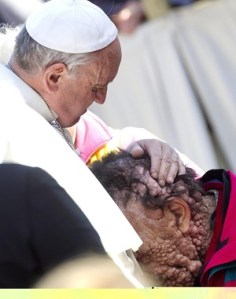
(Pope Francis blesses a leper Photograph: Claudio Peri/EPA)

Over the past few weeks, I have heard visceral and angry comments from others about homosexuality, mostly from professed Christians. Of course, this is nothing new.

I’m sure what has likely stirred the hornet’s nest for many were the recent words of Pope Francis permitting priests to bless same-sex couples. Undoubtedly, many bishops were incensed, and I’m sure Pope Francis expected it. What I’m also sure of is that he didn’t stop to worry about the fallout of his decision or how that would reflect on his approval numbers.

The noise was so profound for me because it came at Christmas. If you have to ask why that matters, I will tell you if you will indulge me. You are free to disagree. I would ask that you consider what I am sharing here in light of our having just celebrated the birth of Christ, which would soon be followed by his short life of loving as God taught him, followed by his unimaginable suffering, pain, and death because of that love.

Let me share the writings of two women here because they beautifully express what I feel:

First, Episcopal priest Cynthia Bourgeault explains the uncomfortable question of what the Bible says about sexual orientation: “How you answer this question depends hugely on what you take the Bible to be. If you believe that the Bible is a single, timeless, internally consistent teaching on matters of human morality dictated by God, then yes, the Old Testament book of Leviticus is definitely uncomfortable with homosexuality. But it is also uncomfortable with menstruating women, shellfish, and pigskin. (And for the record, it has some very harsh words to say about lending money at interest, a prohibition that even biblical literalists seem to find it perfectly permissible to disregard!).”

Oops…

She continues, “Like most other critically thinking Christians, I see the Bible as a symphony (sometimes a cacophony!) of divinely inspired human voices bearing witness to an astonishing evolutionary development in our human understanding of God…. As a Christian, I am bound, when I listen to this diversity of biblical voices, to set my compass by the teachings and the path walked by Jesus himself.”

Oops again…

“Nowhere does Jesus condemn gays or lesbians (or any other person identified in the diverse range of LGBTQ+)…. His harsh words are reserved entirely for those whose certainty about their religious rectitude causes them to condemn others. Jesus is all about inclusion, forgiveness, and empowerment.

I am compelled by my Christianity to refrain from any behaviors or judgments which arrogantly demean the dignity of another human being or cause them to lose hope.”

Now, these thoughts of Alyse Jacobsen:

“In the New Testament, the original Greek words, arsenokoitai, and malakoi, have been translated to “homosexual.” But their original meanings are ambiguous at best. Scholarship suggested the words are closer to describing someone who uses authority to gain sex, someone who uses sex to hurt another human being. There was no Greek or Hebrew word for a committed same-sex relationship. Selective and literal interpretations of the Bible are dangerous.

Jesus would have known about homosexuality. He was an educated rabbi; he would have been able to recite the verses that condemned it. But he never mentioned it. Not once. I find this astounding.

Somehow, we’ve forgotten that our lesbian neighbor is filled with the Holy Spirit, too, that she is also made in God’s image. We’ve forgotten to see her as a whole person, with dreams and goals, and divine inspiration….”

Finally, I believe if we claim to be Christian, we must honestly confront any hatred and prejudice we harbor in our hearts, in light of the only “law” God gave us (Matt. 22:37) –“Love the Lord your God with all your heart, all your mind, all your soul, and all your strength, and love your neighbor as yourself – which is every human being also created by God.”

We are all card-carrying members of a broken humanity. For the love of God, can we PLEASE try not to take our miserable mess and pile it onto others?

What are we teaching our children when we hate? What message are we giving those who are searching for the love of Christ that has been lost to them along the way? How could they feel he is trustworthy? How are we culpable in forwarding a false Christian message that Jesus doesn’t like you because you’re ______________(fill in the blank)?

Would Jesus Invite a Porn Star to the Prom?

(Originally posted on March 23, 2012)

I never attended a prom. Back in my day, with a certain number of credits, short of a diploma, we could obtain a “certificate,” which had no value beyond getting out of classes you hated, which was pretty much all of them for me. Today, you’re just labeled a loser and drop-kicked into the world to fend for yourself.

But prom prep is coming very soon to a high school near you. It’s time for the annual dress shopping and thirty-day diet protocol. Time for the reality check that, for some like me, no one would invite you if you begged and paid for a date with the biggest loser in school. It’s humiliating.

Who knows, maybe it would have happened if a guy like Mike Stone had been around in my day. Here’s the headline I caught in the news a few days ago that prompted this post. Granted, our friend here may have had a different motive than Jesus. But who’s to judge anyway?

Teen’s porn star date to prom scuttled by district officials. 

Now back to Jesus. I know, I know, there’s nothing in Scripture about Jesus’ prom. Do you know why? Why is there nothing about him from the age of twelve to thirty-three when he began his ministry? Did you ever wonder about that? Well, I have a theory (of course, you do, Linda!).

When Jesus got in trouble for going off to the Temple without telling his parents, that was just the beginning of his rebellious streak. His teen years were just around the corner. The hair instantly stands up on the back of the neck of any parent who has raised teenagers – can I get an AMEN?!

On his thirteenth birthday, Jesus invited all the misfits in the neighborhood and a few clowns with balloons to his party, along with his snooty relatives, and they were livid! After that, his relatives refused to attend his birthday parties, which was fine because they were too stuffy anyway!

I’m sure the real challenge for Mary and Joseph was the unexpected letter from Jesus’ principal just before graduation. Fortunately, they hadn’t rented his tux yet. The letter read:

Dear Mr. & Mrs. Joseph (last name unknown),

I regret to inform you that we have had to administer an out-of-school suspension for Jesus. As a result, he will not be allowed to attend graduation ceremonies or prom. We have repeatedly discussed with him the school “rules”, yet he has continued to defy them. We have given him ample opportunities to follow the regulations required of all our students and feel we have no other choice in the matter. Below you will find the documented offenses:

Jesus has demonstrated a refusal to adhere to the precepts of submission to his teachers and repeatedly questions their authority to run roughshod over the troublemakers. He seems to have a misguided concern for the poor, the meek, and the place of women in our society. We have laws and customs, you know! You really need to talk to him about that. We would also caution you to be more aware of these people he is associating with. You know – birds of a feather! I’m just sayin’.

He will receive his diploma by postal carrier.

Regards,

Mr. Caesar,

Principle, Nazareth High School (Go, Lions!)

Now, do you see why Scripture writers probably skipped over this period of Jesus’ life? They collectively decided that teens are too easily influenced by their peers, which could tick off parents. Anyway, back to that dreadful letter…

The letter arrives. Then…that dreaded, you know you’re in trouble, summons,  “JESUS!” (No middle name here either; too bad. Middle names are critical for a parent’s emphasis! So it loses some of its oomph.) But Jesus knew what was coming. “Dad, I can explain.” Joseph was calm and attentive, “Okay, I’m listening.” Joseph was actually proud of his son but contained himself because Mary was listening from the kitchen.

This conversation ended as you might expect – with a parable! (This is where he got the material for his later ministry, trying it out on Mom and Dad.)

“See, Dad, there’s this rich guy who prepared a banquet. He first invited all the “important” people. But they all had some lame excuse not to attend. Now he’s furious thinking of the rejection and the money he wasted on those ingrates. So, he went to Plan B. He ordered more pizza, rented a big ole bus, grabbed the servant, and ordered him not to return until he rounded up every misfit he could find. It’s party time! Pizza and beer with true friends trumps wealth, fame, and fortune! (Luke 14:16-24). Joseph gave him a high-five and assured Mary it was all straightened out.

So, I’ll ask you again – would Jesus take a porn star to his prom?

 Of course, he would have (not as a date, silly!), but along with every lost and broken person God loved and the “popular kids” rejected. And what a grand time they would have had!

Faith Beyond Knowledge: Experiencing God’s Love

For three years, Jesus walked with and taught his disciples. He dared to love those cast aside by society. He healed the sick, turned unbelieving hearts toward God, and challenged those who believed they held the ultimate power.

The problem was that his disciples wanted to follow him on their terms. But, time and again, they failed. Why? Their desire to change was frustrated by their inability to know God as Jesus knew Him. Their frame of reference for God’s love was within the realm of deserving and undeserving. It was something they could control through their actions.

In Jesus’ Passion and death, they witnessed his total self-giving to his Father. So likewise, God revealed His radically gratuitous love for his Son, the disciples, and us through the resurrection. Though that love is given freely, it calls for a response from us. I can’t help but wonder if that’s why we, like the Israelites, settle at the foot of the mountain in a comfortable, risk-free faith. “Nuh-uh, I ain’t goin’ up  there!”

Before Jesus’ crucifixion, all of his wishy-washy disciples ran away in fear of meeting the same fate. (Just a little reminder here: the women stayed! You know that, right? Power to the women!)

Anyway, the manly men finally came out of hiding and ran headlong into Jesus transfigured. There was now no denying that what they witnessed they were compelled to share with a lost and hurting world. That reality released within them an unshakable love beyond their human capacity.

Can we possibly grasp the implications of that Love in our own lives? We zealously take care of “number one” in a world laden with mistrust and fear. How does that correlate with the fact that we were made in the image of God? It doesn’t.

As Christians, we, too, were created anew by the resurrection and empowered by the Holy Spirit. That is Good News! And we have a mandate to take that Good News into the world. If fear holds us back, it is grounded in the denial of who we are. God’s sacrificial love is meant for all, and I am to be an instrument of that Love, or my faith response is inadequate.

Confession time. For as long as I can remember, I have wanted to be an “instrument” of God’s love on my own terms, just like the disciples, and I blew it – big time – just like they did! But I’m still breathing, so I still have time for a course correction. Sooooo, let me get all my “stuff” out there now and pray for that clean slate God is so good at freely offering us. You might want to fasten your seatbelt!

I always felt the need for certitude about something, anything, in my messed up, confused, and broken life, but I wasn’t sure about trusting that to God. I mean, up to that point, He didn’t seem to pay any mind to me or my trials. So, I was convinced I was screaming into an echo chamber when I complained about the raw deal life handed me. It sucked for real! So, I went about creating a new and different me, and it seemed to work just fine – on the outside – for a while – until it didn’t.

After my husband and I were married, I became a card-carrying member of the Catholic Church. Then with a cross around my neck and a big fish on the bumper of my car, I sat and waited for the angels to break out in song. It never happened. I never got so much as a thumbs up or atta girl.

For several years after my official dunking, I lived in a state of doubt, always questioning the very essence of my faith. I read the Bible from front to back even though my eyes glazed over, trying to wrestle with the Old Testament. Still, I came away from that experience believing I now knew everything about everything God, Jesus, Spirit, and leprechauns (Okay, not leprechauns, I just threw that in to see if you were paying attention), but God, Jesus, and Spirit, yes!

I was also good at making others look bad to make me look better. I could easily admonish them for all their faults and failures without skipping a beat. I could even quote Scripture verses to shore up my convictions. “Oh yeah, you think you’re a shoo-in for heaven? Well, I’ve got news for you – you’re screwed. Matthew says so, ‘For the gate is narrow, and the way is hard that leads to life, and those who find it are few – very few – almost no one!’” (Matt. 7:13–14). I hate to tell you (NOT!), but this is not your lucky day, and tomorrow ain’t lookin’ too good either if you don’t change your ways! Don’t say I didn’t warn you. You’re welcome!

Jesus side-eyed me for my attitude more times than I care to admit!

(Tenor)

Then, one fine day in 2006, I was accepted into a graduate program at Aquinas Institute of Theology! Yeah, surprised the hell out of me too! Now, I thought I would have even more ammunition in my arsenal to judge and condemn others while promoting myself. Sweet!

I have shared my experiences at Aquinas in previous posts. So, let me just say that, like Paul, I was knocked off my high horse and taken to task because of an arrogant assessment of myself. It was not pretty.

Since I am very hard-headed (duh), my transformation was is, very slow. Truth be told, I muddled along for several years after graduation trying to sustain my convictions. After all, who would I be if not this person I created to reinforce my sense of self, albeit a very fragile and false self?

So I trudged along searching – for what? I didn’t know. Longing for something out there that could give my life meaning. I tried desperately to fill the void. I left the Catholic Church in frustration and wandered into other Christian churches. Some sent me running out the door with my hair on fire! Why was I struggling to find a faith with the correct beliefs that spoke to me? For a moment, I considered communing alone with nature! Then I envisioned St. John the Baptist running naked in the woods, eating bugs and swatting mosquitoes! No thanks.

And then – drum roll please – my glorious and long overdue AHA moment arrived at my doorstep unannounced. In my search for a belief system that I could buy into, I suddenly realized what I was actually longing for. At that moment, experience and dogma clashed head-on, and I understood that I wasn’t searching for correct beliefs. That has never been what drew me to God.

The experiences along the way showed me God’s love beyond anything I had ever known. It just took this long to accept that God could love me like that. Experiencing God in relationship, not knowledge of God, wells up within the very depth of our hearts – where He resides. I was finally home within my very being – where my deepest longing and hunger reside.

I could beat myself up for all the years I wasted wanting faith on my terms, but God has spoken tenderly into my brokenness and heartache. That voice was not a voice of condemnation that I was taught to believe was God’s.

It’s not helpful that we are reminded every Lenten season that He had His beloved Son killed because of our wretchedness. NO! I believe Jesus was killed by a power structure that feared him. He lived a life that he had to know would get him killed, but he did it anyway out of a self-giving love at the core of his being.

I now trust that the God I long to surrender to also longs for me. The God who knew His Son would suffer terribly and die showed us His unwavering love, mercy, compassion, and forgiveness in the person of Jesus. John 15:12-13 tells us: “My command is this: Love each other as I have loved you. Greater love has no one than this: to lay down one’s life for one’s friends.”

Seeing Jesus’ life, death, and resurrection in the context of John’s gospel of love has cast a new and beautiful light on what I now see when he says, “I am the way”. His life and love show me that if I follow in his way, I will be living my purpose: to love unconditionally, serve where I am called, and offer freely the same forgiveness and mercy God has shown me.

The Easter question for us becomes, “What do you believe about me?” What I say I believe must manifest itself in the way I live my life, or it is a lie.

A Blessed Easter to you all!

Non-Refundable LOVE

(Originally posted December 2020)

We all know the words of 1 Corinthians 13. Right? It’s one of the most familiar verses in scripture. Who hasn’t been to a wedding, or two, or twenty, that present it as a reminder of the love and commitment a couple is offering to each other?

But do you know the original intent of Paul when he wrote it? You may think he sat around the campfire with his “flock” and wrote this song to commemorate the establishment of his new faith community (though it’s not credited to him, and he gets no residuals. Pity): https://www.youtube.com/watch?v=bYJMtn6IJeE

Anyway, everybody’s high-fiving as Paul slaps his own back for his ingenious efforts in the name of love. He may have even imagined himself receiving a Pulitzer Prize or at least Time’s coveted “Man of the Year” award. Temporarily losing sight of his own advice about “pride” and all.

Okay, fine…truth be told, none of that happened. He wasn’t in some mushy mindset when he wrote those words to the Corinthians. Actually, Paul wrote them in a fit of anger. I kid you not.

When he established Corinth, he imagined it to be perfect. God’s dwelling place, a community of love and care for each other and all humankind. Peace on earth, Goodwill to men…and all that.

But things quickly fell apart. He was peeved at them because of their short memories. As soon as Paul was out of sight and on his way to his next church planting, the Corinthians began to fight and argue over everything. The rich and powerful immediately began to demand more and more for themselves, believing they deserved it. Jealousy often led to striving for importance and self-promotion.

But the deepest split came when the self-proclaimed “authorities” felt compelled to form a committee to decide, and then pronounce, who was going to heaven and who was headed for hell because of their messed up beliefs. So, they drew a line in the sand: the “ins” over here, the “outs” way over there“keep going till we tell you to stop”! Love got lost in the scramble for importance. In short, they were all a mess. Sound familiar?

Sure, initially, they may have bought into the idea of love. But it wasn’t the love Jesus lived and died for. Instead, they wanted it on their terms: less demanding, just as we do today. We want the watered-down version that puts loving my new car in the same category as loving humans or puppies. (I know, puppies are much easier!)

Anyway, perhaps in our own time of so much strife, it would behoove us to revisit 1 Corinthians 13 in light of what Paul was trying to get across to those hard-heads, immature in faith and lacking the love that requires self-sacrifice – a love rooted in compassion.

So, here goes.

Love Never Fails – 1 Corinthians 13:1-8 (NIV)

If I speak in the tongues of men or angels but do not have love, I am only a resounding gong or a clanging cymbal. Like when I put myself and my wants and presumed needs first.

If I have the gift of prophecy and can fathom all mysteries and all knowledge, and if I have a faith that can move mountains, but do not have love, I am nothing. As in, “I know everything about everything that matters – to me. That’s why I have given myself all authority to laud it over you.”

If I give all I possess to the poor and give over my body to hardship that I may boast but do not have love, I gain nothing. As in, “Look at me, ain’t I special?!”

Love is patient – except when you annoy me.

Love is kind – except when I don’t get my way.

It does not envy – except when you bought that new, nicer, shinier car before me.

It does not boast – except when I excelled in some project at work, got a significant raise, and a corner office.

It is not proud – except when I installed the biggest pool in the neighborhood.

It does not dishonor others – except when they deserve it because they’re being poopyheads.

It is not self-seeking – except when I believe I deserve fame and fortune, power and authority, and fewer wrinkles.

It is not easily angered – except when my kids can’t seem to behave appropriately – by my rigid standards. 

It keeps no record of wrongs – except for all the people who just can’t seem to keep their broken, messy attitudes out of my broken, chaotic life. 

Love does not delight in evil but rejoices with the truth – welllll, I don’t necessarily delight in evil. It’s just that I can sometimes stretch the definition of “truth”.

It always protects – those innocents who suffer and are downtrodden.  

Always trusts – our God, who never fails us.

Always hopes – in a better way, a better life for all humankind.

Always perseveres – even when things seem impossible.

Love never failsNEVER! END OF STORY

And finally:

Diana Butler Bass says it beautifully, “Yes, we may be in hell. The world may be hellish. COVID is hell. Our political crisis is hell. The climate crisis is truly hell. But there is another story, another song, a different word. A word we can speak and a word we can act upon. Peace has been born. We wait for its fullness….we claim the power of the Christmas story to bless, to redeem, to transform the stark earth. While “death howls in strife,” we embrace and embody the poetry of God and beat back the walls of hell. Make ready the stable of your heart. Fear not. And get busy with the work of peace.

Peace to you and your loved ones this Christmas. It is certainly a Christmas like no other we have experienced, a Christmas that may seem to counter all we have believed about goodness and love. But only if we have lost sight of the One who changed everything for all of us, Christian and non-Christian alike. This Christmas Day, may we finally “see” Jesus as the Incarnation of God’s immovable, constant, abiding, majestic, unfailing LOVE for ALL: every single messy, broken one of us! A LOVE that is not returnable. You can refuse it if you want, but God will keep trying. It’s like that ugly tie you got – again – from Aunt Lucy. (You know she buys those in bulk at after-Christmas sales, right? Yep, you’re getting one again next year!)

I’m Right and You’re Wrong –DAMN IT!

We are in the midst of a battle. Anger and violence are played out in the media daily. It’s deafening, and activists are on both sides of the conflict. Both have dug in their heels and refuse to budge. How many times have we seen in-your-face confrontations?

Fight cloud

So, the question then becomes: How many of those times have we seen adversaries turn into allies who decided to work together with the determination to change things for the greater good of our country? How many?

We’re seeing a win-lose struggle, and when there is a winner, that necessarily means there is a loser.  So, what’s the answer? How do we get beyond this impasse that is adding so much suffering to an already disintegrating situation?  How about this novel idea? How about if we just go home and work on our own issues first (and if you don’t think you have any…well…that’s an issue)?  Crazy huh?

No matter what I believe, no matter how passionate I am about changing the world,

I am really the only person I have the power to change.

I would like to share with you my course correction after years of being a selfish, stubborn, know-it-all believer in the power of God to send all heathens to hell if they didn’t straighten up! I was sure that was my assigned duty here on earth, and I was really good at it! My buddy Paul and I both got knocked on our butts – in a loving way, of course. God knew I was used to getting knocked on my butt and would come out fighting!  So, after he got my attention, he gently went after my heart instead. Sneaky.

I want to touch on three areas in the past fourteen years that have profoundly impacted my life. What’s impressive is that I have no bruises to prove it, but that’s because hatred, not Love, bruises.

The changes I am referring to are my faith, politics, and my self-centeredness vs. other-centeredness:

MY FAITH: – back in the day, I could quote many scripture verses proving that anyone I disagreed with was destined for hell. Have a nice trip! I could justify my superior attitude and what was clearly my god-given responsibility to save lost souls. That is until I got to graduate school in 2006.

It did not take long to see the error of my ways and the folly of my “beliefs”. But, and here’s the point I want to make in all of this, the professors I was so blessed to know in that three years were powerful influences in my life. And yet, not one of them shook an angry fist at me to announce that I was an idiot, which they could have. I saw something in them that helped me to see, really see, the error in my thinking. They were loving, compassionate, grace-filled teachers of God’s unconditional love for all of his creation. They taught me, not just through studies like reading the works of Thomas Aquinas (geeeezzzz, that was painful!), but more importantly, through their own example and lives. It wasn’t because of a need to be right or to make demands, but because they simply loved. I wanted to be like them. I wanted to grow in a faith like theirs that imitated Christ. They helped change my attitude about so many things. But, at the end of the day, all they had the power to do was encourage my willingness to change from the inside out. It was really up to me.

MY POLITICS: What I learned about myself at Aquinas carried over to a more nuanced understanding of the part I play just in voting. Before this, I was a one-party voter. Admittedly, it was much easier back then. Walk into the polling place, pull the lever for my party of choice, get my “I Voted” sticker, and go home. Never mind that I usually didn’t know who or what I was pulling that lever for. It didn’t matter, though. I was confident in the knowledge that I did my duty. I think today, many people like me now know how critical it is to be informed and choose for everyone in this country, especially those who have been kicked to the curb and feel they have no voice. And, again, my movement away from “don’t really care” did not come about by brute force. What woke me up to my responsibility and privilege to do my part for the sake of others came from an enlarged heart space, not someone yelling in my face.

Self-centeredness that morphs into other-centeredness – giving instead of taking. Seeing, really seeing, the worth, dignity, and humanity of those the world rejects. And not only seeing them but loving what we see because if you look close enough, you will see Christ. And I just can’t get enough of that.

I would challenge you to just sit for a moment and think of recent stories you have seen on TV or the Internet that either enraged you or spoke into the depth of your heart so powerfully that you cried.  Then ask yourself, which of those scenarios comes from God and which is motivated by an ego-driven, self-serving purpose?

I was recently involved in a conversation with someone who is very passionate about their beliefs concerning what we are experiencing. This person wanted to battle until the other person caved and cried uncle.  But, hey, both stood their ground. In the aftermath of that train wreck, I commented that everyone who disagrees with you is not your adversary. When you view every discussion with someone who feels differently as an opportunity to bully them into your way of thinking, the conversation shuts down, and you both lose.  Then I get the equivalent of a Bible-lashing in Matthew 21:12-13 to remind me that Jesus got angry and threw s*#t.

Okay, first of all, many “stories” in scripture are meant to offer a teaching. Does that scripture verse mean that Jesus was this angry bird who couldn’t control his temper? We could take this to a discussion of “righteous” anger, but that’s not the point. Do you think that table-tossing anger changed ANYONE? We don’t know, of course, but I’m guessing not.

How many of Jesus’ acts and teachings call us to love? How many people followed him despite the danger, especially women, because he offered what their hearts longed for. He came and eventually died for it, and so many others after him were martyred for. So it must be a big deal!

What was one of the last things Jesus said to his disciples? Come on, you know: “Okay, no more Mr. Nice Guy! I’m outta here now, so it’s up to you to carry on. Go on out there and beat everyone who refuses to follow me into compliance. Got it?”

Hmmm.  Yep, sign me up!

We know, of course, that Jesus was very passionate. However, he showed us that passion is not the end of the story. When that passion is turned into service to others, everyone wins, and God does his happy dance!

Why You Care Matters – BUT – How You Care Matters More

I recently read Alan Cohen’s quote, Please show me is one of the most powerful prayers you can speak.”

I bulked at that, or more accurately, painful memories and an ego ever on high alert, bulked, “It’s not that simple! Life is not that simple!” That comes from a place long ago when I learned not to trust anyone but myself (how scary is that?!).

As a child, I needed to trust my mother, so I could learn to trust the world around me. But she proved to be untrustworthy, which, in turn, meant the world was also untrustworthy. The world loves those who don’t know who to trust and empowers the ego to guide itself right off every unmarked cliff until we begin to doubt ourselves.

My ego-driven mind wanted every aspect of my life to be certain and laid out clearly. I believed the Spirit I dealt with didn’t care much about its guidance in my life, “You’re on your own, kid. Good luck!” Old memories, combined with my return again and again to my default settings, dredged up my monumental failures to prove I was right – hoping that Spirit-guy would finally see that I had good reason to question everything.

Two events that always come to mind are: (1) writing a book and (2) attending graduate school. Both were significant and frightening decisions that did not turn out the way I had planned. It then seemed that the outcome of these events was confirmation that Spirit-guy could not be trusted either. And just to remind him, we had a little review:

 1) One day, out of nowhere, you clearly told me to “write a book”. That was you – right? Admittedly, after laughing hysterically, I finally did believe you and wrote the damn thing. That led to me imagining myself becoming a famous and sought-after author. But that’s not what happened, is it? No!

2) Then how about this? When offered the unbelievable opportunity to attend graduate school, after much consternation, I acquiesced. Even though I fully believed I would be discovered as a fraud and be tossed out on the street. When I finally realized I might actually accomplish such a crazy endeavor (which took nearly the entire three years I was there), I began to imagine myself becoming a beloved Pastoral Associate—fulfilling my need to be somebody special. But, that’s right, that’s not what happened either. Are you still with me, Spirit-guy?

When I read, “You can avoid painful errors and trials by letting the Spirit guide you”, my “failures” seem to confirm that that did not apply to me. But in a rare moment, I sat quietly and prayed. The response came quickly. I suppose because it has been the same obsessive struggle I have had for years, and you were probably peeved, weren’t you?!

Spirit (eye roll here), “Sit down and take a deep breath, Linda. Ready? Here we go for the bizzilionth time.”

1)  Yes, I did prompt you to write a book and attend graduate school. And, no, it did not catapult you into fame, fortune or recognition. No associate position in the church or loads of book sales. But it did develop into your blog, which has touched lives. How many? It really doesn’t matter because that’s not the point. The experience has changed your life in ways you never could have imagined beforehand – right?

Can you not see how much your faith grew and flourished when you cared for the dying as a Hospice volunteer? Then, working with the homeless, you showed them love, when they only knew rejection. No award, book contract, or flurry of accolades will come close to invoking those tears of love and compassion you reveal every time you reach out to those who suffer.

Maybe a review of Luke 15:4-6 is in order here. You know – when Jesus dropped everything and went after ONE (you!) lost sheep. ONE! And then he danced and sang all the way back to camp like he had hit the lottery!!

2) Admit it, Linda, it took these experiences and many others to strip away enough of your brokenness (not all, but enough for now) to open you to the love of God that had been gathering dust in your heart for a very long time. And, yes, I’m still going to be there, as always, to offer you some pearls of wisdom, even if you pretend not to notice me – the elephant in the room!

Anyway, those are the things you would probably never have considered being capable of before God wrested your shallow ‘faith’ from you and replaced it with a love for others.

Purpose can never be driven by the world’s definition of success. So, stop already putting expectations on the outcome!

Now, come on, we have lots of work to do, and you aren’t getting any younger, you know. Just sayin’.

Can you relate? Have you experienced your own come-to-Jesus moment, but you’re not sure what that means for you?

When Jesus said, “follow me,” it was a radical call, not an invitation to tea. It wasn’t the Jesus version of Simon says, “Touch your toes. Wiggle your nose. Bend your knees. Pat your head. Here’s your prize.”

You realize, don’t you, that Jesus never said, “Go to church”. Never. Church is where we often hear the Word of God, rejoice for a millisecond, and then go home to cut the grass. Following Christ means living the Word; it means being Christ to others. He told us, “I have suffered the hatred of those in power to serve those at the bottom – the forgotten and rejected. If you follow me, you will do even more and, yes, you will suffer for your efforts as well.” Our response to that call should be a resounding, “Yes”! But, it’s often, “I’ll get back to you.”

Remember that all the disciples ran for cover when Jesus was taken away. When they saw the empty tomb in unison, they proclaimed, “Bummer, this is not how we imagined it turning out.” (Does this sound familiar?) So, when Jesus showed up unannounced at their pity party, he was surely in the same place Spirit-guy has been with me so often, “Okay guys, let’s try this again. First of all, let’s get this out of the way – none of you will be sitting on any throne no matter what aspirations your mother has (Matt. 20:20-21). You’ll be sitting in the muck and mire with the least among you and, get this – you’re going to love it there because that’s what you were created for, selfless love and compassionate care for the lost and hurting.”

Today, we have been inundated by images and news concerning Covid-19, our broken economy, hunger and homelessness, and the BLM protests that have shed an uncomfortable light on the inequities in this country.

People are suffering and dying every day because they have been victims of Covid, hatred, or both. How are you affected by these realities? What do you think of when you witness this most profound moment in our history? Do you turn off the TV and retreat to your safe place? Do you pray or send a check to a food bank? – I’m not discounting those things. Both are needed for sure. But, is there a tugging on your heart to act on that reality?

This is a time of reckoning for all of us who consider ourselves decent human beings. Never mind any label you may attach to that: Christian, Jew, Atheist, none of the above, whatever – just decent human beings who know deep down we are called to lift our “caring” to a whole new level.

I love the expression: “Bidden or not bidden, God is still present”. God still lives and moves and has his being in the very depth of your heart, whether you believe in him or not. And even if you don’t, he just hangs out there, hoping you will one day acknowledge him and, in turn, recognize who and Whose you are. He’s like the heart whisperer, “I love you, you are mine, and your life matters.”

If I ever sound like I have totally got my act together, don’t think for a moment that it’s true. We are all a work in progress. We have all sinned and fallen short (Romans 3:23). I’m just thankful that God’s love and grace know no bounds. Our weaknesses don’t anger him, and our fears won’t push him away. On the contrary, he is merciful, forgiving, empowering, and likely has a wicked sense of humor! Oh yeah, and he has never been untrustworthy. Not once.

So, let’s do this. Yes, sitting quietly is important to discern how and where you are called to serve. But then, like Jeremiah, get off your butt and get over yourself because God will give you all you need to do what he calls you to do. That’s a promise we can all trust.

I will end with this wisdom from Anthony DeMello, SJ:

Once upon a time, a disciple asked the elder, “Holy One, is there anything I can do to make myself Enlightened?”

“As little as you can do to make the sun rise in the morning.”

“Then of what use,” the disciple asked, “are all the spiritual exercises?”

“To make sure,” the elder said, “that you are not asleep when the sun begins to rise.”

Hungry for LOVE

So many Americans pride themselves on what truly is a self-serving and glaring distinction between love of self and love of neighbor. But there is no such distinction if we are open to seeing the deepest truth of our connectedness because we are all created by one God to be in relationship with Him and with each other. Our perceived sense of control and security; our self-imposed separateness from “them” breaks the bond of our very creation and the heart of God.

Still many are too afraid to relinquish the precarious grasp they have on their self-proclaimed and arrogant superiority over others they see as “less”.

What, or who, gives anyone the right to determine who is worthy of love, dignity, compassion, and basic kindness? This country is bloated with anger and violence. We are quickly becoming a culture of hatred.

It is a frightening reality, especially for our children, which makes it even more imperative for us, if we call ourselves believers, to change the tide. To speak out against injustice and speak up for the downtrodden just as Jesus taught us in the Sermon on the Mount (Matthew 5:3-10):

Blessed are the poor in spirit, for theirs is the kingdom of heaven.

Blessed are those who mourn, for they will be comforted.

Blessed are the meek, for they will inherit the earth.

Blessed are those who hunger and thirst for righteousness, for they will be filled.

Blessed are the merciful, for they will be shown mercy.

Blessed are the pure in heart, for they will see God.

Blessed are the peacemakers, for they will be called children of God.

Blessed are those who are persecuted because of righteousness, for theirs is the kingdom of heaven.

Blessed are you when people insult you, persecute you and falsely say all kinds of evil against you because of me. 

Rejoice and be glad, because great is your reward in heaven, for in the same way they persecuted the prophets who were before you.

In a 2012 speech to students at Georgtown University, Bono, of U2, challenged the almost one thousand students present to see the invisible (as he continues to challenge all of us).

Because when you truly accept that those children in some far off place in the global village have the same value as you in God’s eyes or even in just your eyes, then your life is forever changed, you see something that you can’t un-see.

This song, Invisible, and actually his life, are an incredible witness to that truth. It’s about getting real; about getting beyond self and realizing the connection we have with everyone. It is about the human dignity of every person as a child of God. We are to exclude no one – NO ONE.

Listen to these words:

I’m more than you know/ I’m more than you see here
I’m more than you let me be
I’m more than you know / A body & A Soul
You don’t see me but you will/
I am not invisible / I am Here.

There is no them / only us/ only us
there is no them / only us / only us
There is no them / only you, only me
There is no them.

Meghan Clark, writing in Catholic Moral Theology, commented on the song saying:

The ultimate violation of human dignity is to no longer be counted as a human person. The response must be inclusion and participation. Once I recognize that you have human dignity, that you are a child of God, that you are the image of Christ – I cannot un-see that. 

All of this has hit home for me in a more profound way than ever before (even more so since our time spent in Rwanda) since I have been working with the homeless in St. Charles County. We have the resources to meet their basic human needs as defined by Abraham Maslow in 1943:

Physiological needs are the physical requirements for human survival. Physiological needs are thought to be the most important; they should be met first: Air, water, food, clothing and shelter.

But, as St. Mother Teresa so powerfully states it isn’t enough:

Mother_teresa hunger


The Things we do for Love

everlasting love

What if you believed, as I do, that Jesus did not die to save us from our wretched sins? What if God sent Jesus to show us an incalculable, immeasurable love without regard to our sinfulness, knowing it would be that very sinfulness that would be the cause of his beloved Son’s death? Would that make a difference in your life?

Imagine my excitement when I recently read the following meditation by Richard Rohr. Finally, one of my heart’s deepest beliefs is put into words I could not express more powerfully:

Love, Not Atonement

The common Christian reading of the Bible is that Jesus “died for our sins”–either to pay a debt to the devil (common in the first millennium) or to pay a debt to God the Father (proposed by Anselm of Canterbury, 1033-1109). Anselm’s infamous Cur Deus Homo has been called “the most unfortunately successful piece of theology ever written.” My hero, Franciscan philosopher and theologian John Duns Scotus (1266-1308), agreed with neither of these understandings. Scotus was not guided by the Temple language of debt, atonement, or blood sacrifice (understandably used in the Gospels and by Paul).  

After Anselm, Christians have paid a huge price for what theologians called “substitutionary atonement theory”–the strange idea that before God could love us God needed and demanded Jesus to be a blood sacrifice to atone for our sin-drenched humanity. With that view, salvation depends upon a problem instead of a divine proclamation about the core nature of reality. As if God could need payment, and even a very violent transaction, to be able to love and accept “his” own children…. 

For Scotus, the incarnation of God and the redemption of the world could never be a mere mop-up exercise in response to human sinfulness, but the proactive work of God from the very beginning. We were “chosen in Christ before the world was made,” as the hymn in Ephesians puts it (1:4). Our sin could not possibly be the motive for the divine incarnation, but only perfect love and divine self-revelation! For Scotus, God never merely reacts, but always supremely and freely acts, and always acts totally out of love. Scotus was very Trinitarian.

 The best way I can summarize how Scotus tried to change the old notion of retributive justice is this: Jesus did not come to change the mind of God about humanity (it did not need changing)! Jesus came to change the mind of humanity about God.

That changes everything. Or at least it should.

John 3:16 tells us, “For God so loved the world that he gave his only Son.” Where does it say, “God was so fed up with us that he sent His only Son to straighten us out and then die to erase our sins”? Because, hello, his death didn’t erase our sins! Think about it. Was everyone suddenly perfect after that? NO! The horrors we have committed against each other through the ages would defy logic if that were true.

So, believing that Jesus died to atone for our sins doesn’t make sense. Does it? At least, it doesn’t to me. I mean, come on, can you see Jesus returning to His Father as they contemplate his thirty-two-year experiment gone bad? “Okay Son let’s try something different. Can’t do the whole wipe the slate clean thing again (Genesis 6:5-10:32), I promised I wouldn’t.”

Now, you could counter with the possibility that the whole “Love” thing didn’t work either. After all, we are still sinning and hating and killing each other. BUT…many of us (I hope that includes me), in spite of ourselves, are really trying to change each day; trying to find our hope in the love and mercy of God; trying to love our neighbor as ourselves. Just like Paul, we often fail, but we know God’s love will prevail in the end.

How often do we read stories of people, from biblical times to the present who have given their lives for others without regard for themselves? All Jesus’ disciples, except for John, died martyrs for their faith. Would they have done that for someone who came to tell them how wretched they were?

If Jesus had come to teach us a lesson I’m imagining him bemoaning his fate for the likes of us. His own disciples were a bunch of misfits. Why didn’t he just shake his head in disgust and walk away? “They’re hopeless losers. I’m outta here”! And yet, we seem to find it easier to believe the Atonement theory. Why? Perhaps it makes God a cruel judge who doles out conditional love which brings Him down to our level and justifies a lukewarm religion we can easily become comfortable with. That kind of God you want to keep at arm’s length because you never know what will set Him off!

If you can’t wrap your head around the inexhaustible love God has for you, perhaps it’s time to quit comparing Him to earthly fathers, even if yours regularly received the “Father of the Year” award. He still has his faults.

My father was not abusive like my mother, but he was an absentee father. He never showed us affection: no hugs, no sense of “gosh, I’m really glad you’re here, glad you’re my daughter.” No expression of love. My great aunt once told me she never remembered either of my parents even holding us. It took me a long time to realize and accept that he couldn’t express love, he just didn’t know how because no one in his life ever did, a reality of his humanness and his parents humanness, and on and on.

The reality of our humanness is why, I believe, God came to earth incarnate – to show us His love in the flesh. This is what it looks like people.”

“Even though we were still sinners” (Romans 5:8).

May we witness anew God’s magnificent LOVE for each and every one of us. My prayer is that we will live fully in the light of that LOVE that has no bounds, knows no limits, and believes in our intrinsic worth – even when we don’t.

Here’s a question to ponder at the foot of the Cross: Could you be so courageous as to give up your life for a friend – or more importantly – the jerk down the street that never liked you and would likely never change after your funeral?

May you know the amazing and unconditional love of God, the peace of Christ, and the fellowship of the Holy Spirit like never before!

And the Winner is…..

(Wendy Mass)

“Christians are happier than atheists”. That was the consensus of a CNN article in 2013. Duh, you say. Well…hold onto your halos folks. It’s gonna be a bumpy ride to heaven. Here’s the article if you’re so inclined to read it.

Richard Wade, an advice columnist for the blog Friendly Atheist, wrote in response to another article about the CNN report, “The takeaway for most lay people is ‘Atheists are unhappy people.’ … How do you quantify ‘happiness’? How do you quantify ‘analytical thinking? Even in their acknowledgments about the possible biases in their study, the authors still use absurd and meaningless terms like ‘militant atheist,’” he added. “This study suffers from the same negative stereotypes about atheists that most society has, and it has simply reinforced that prejudice with more muddled thinking.

As I was reading the above article, another one caught my eye, so I pulled it up too. The caption was Gay detective’s mother booted from church.

I wonder how the researchers of the first article would have interpreted over 3300 comments on the second one. You can read them too, but here are just a few from so-called “Christians” My BS meter was going off a lot, but there were some honorable mentions:

  • From Dale, If God ever does light this planet on fire, I pray that those churches of hate and prejudice should be the first to burn.” (Wow…can you feel the love oozing from our friend Dale here?!)
  • From Starr: “May God treat them the way they have treated this woman.” (Yeah, go get em’ Starr. That’s a sure invite to your church!)
  • Then Minnie Poe asks: “How do you justify I Corinthians 5:11 cause to me that is the same as saying even if it is your own child you are not even to eat a meal with them.” (I love when people “quote” scripture)

Okay, I’m done.

Except for the following comment which I believe tells it all:

  • From Katy: “Religion preaches hatred…glad I comprehended that at a young age and left Catholicism. Now I am a happy Secular!”

Our egos are forever getting in our way and “Christian” egos are scrumptious, lip-smacking fodder for unbelievers. God certainly gave us minds to use. But when the mind is given dominance over the heart, again Rohr says, “The mind starts steering, judging, analyzing, fixing, controlling, and trying to dominate….your endless mental commentary on everything. It really doesn’t matter what you think about things, believe it or not. This is a revolutionary and humiliating breakthrough for most people. What matters is WHAT IS.”

I believe that when the mind controls our every thought, word, and action it is because we do not have the courage to accept our own imperfections. We make our life’s mission to fix, manage, or adjust everyone else because we know for a fact that they are imperfect slobs in need of a Savior.

news flash

Sorry to inform you…none of us have been designated Savior of the world. That position is already taken. The sooner we all realize that the sooner we will stop sending people like Katy running away from God. He’s not pleased with us when we do that, you know. As a matter of fact, the hairs on the back of his neck stand stiff when he sees us acting or speaking like we’ve forgotten we belong to him. Unfortunately, I manage to forget that far too often as some snarky thought or remark manages to slip past my not-so-vigilant-act-like-you-have-the-tiniest-bit-of-Christian-love monitor.

When you are tempted to “set someone straight,” remember that in every circumstance, God calls us to manifest his love at that moment, to that person. Now, look back at the article and comments above and tell me who Christ was for all the people involved? Was it the church that kicked the mother out? The “Christians” who posted mean, insensitive comments?

Do we see God in the actions of the likes of Westboro Baptist Church, which is always in the news because of their hatred toward others? Do we see him in you or me when we judge and speak hatefully to or about others and refuse to accept them?

And let me say this about quoting scripture: That’s fine. But if you find yourself frantically searching with the only purpose of finding that one nugget to smack someone sideways…knock it off! You can cut and paste your beliefs and certainties to try and prove yourself all day long, but what will you have gained for God’s kingdom? Besides, that someone will just cut and paste their own “proof” that they’re right and you’re a moron. And then what?

Words of wisdom from Shane Claiborne, “Something powerful happens when we can connect our faith with the pain of our world…. We’re not throwing out the things we believe, but we’re also focusing on practices that work out those beliefs.  I’m hopeful because people have grown tired of a Christianity that can say what it believes on paper but doesn’t have anything to show with our lives. Ideologies and doctrines aren’t easy things to love. 

“You can show your love to others by not wishing that they should be better Christians.” –Francis of Assisi

And finally, what your mother always told you is still valid today, “If you can’t say something nice, keep your mouth shut!”

Why do I HAVE to Love People I Don’t Even Like?

If I say I love ice cream – which I do – INTENSELY! – it seems very extreme. After all, I’m sure my reaction to my first taste was, “Hum, I like this stuff.” But “liking” ice cream is not pining for it, dreaming about it, or finding every opportunity to indulge in it. That came later – but not much later.

If I just liked it, I wouldn’t ask my husband to hide it from me and then search for it when he’s not here. Which is kinda funny since the only place he can hide it is in the freezer – “Oh, my…there it is!” And, I might add, I grew to delight in the search like it was some kind of hidden treasure. (Matthew 13:46)

Keep in mind that pining, dreaming, and lusting after “things” makes God VERY unhappy. Now we’re getting into the weeds here because we throw the word “love” around so indiscriminately it has lost its true meaning and significance. If I can love ice cream more than my neighbor what does that say about me in light of 1 Corinthians 13:13? Love trumps it all!? Everything. Nothing in all of scripture is more important. People are willing to die for love of God and others (John 15:13), not things.

Loving people can be very difficult. Ice cream is more comforting and doesn’t get on your last nerve. You may be in a relationship with someone you have never liked. Like, I don’t know…that obnoxious cousin Eddie?! How do you get to the love part if you’re stuck there?

eddie vacation

I have been reflecting on that question in light of my own relationships. In particular, my family of origin – more specifically, my relationship with my brother and sister. A little background would be helpful here: My sister is eight years older than me, and my brother is two years older. So, you know what that makes me – that’s right – the “baby.”

me as baby
What’s not to love here?!

Being the baby of the family never really afforded me any special perks. Even so, my siblings treated me like I needed a constant reminder that I was NOT special. When we were left alone, they relentlessly tormented and bullied me. To be fair, I probably was obnoxious. But that didn’t give them license to beat me up and do everything in their power to get me in trouble with our parents.

three stooges

When I was younger, my mother forced my brother to play with me because I had no girlfriends to play with. He and his friends would throw things at me and try to dismember me with a Frisbee. That damn thing hurt, but I never let them see me cry! Sometimes they would just chase me around the yard until I gave up and went inside, only to return the next day for more.

My sister would initiate fun activities for her and my brother and intentionally exclude me. Once, I was so angry with my brother’s unrelenting teasing that I put my fist through the glass of a door he slammed shut on me. Of course, that hurt too, but no tears from this tough kid!

I’m not sure what my parent’s reasoning was the Christmas they gave my brother and me one sled – to share. That ended badly when his friends chased me down the hill on theirs, trying to intimidate me into leaving. I swung mine around just in time to knock out the two front teeth of one of them. YES! It was pretty satisfying, even when my brother ran home to tell my mom, and his friend ran home crying. I knew it would not go well for me, but I didn’t care.

As bad as all that was, what makes it worse is that I do not recall any happy moments to offset our feelings toward each other. Soon after our mother died, I called my sister. She had been drinking at the time and cried, repeatedly saying, “Mom loved you best”! – I was so surprised to hear her say that. My recollection was that our mother never loved anyone.

After our father died, we rarely saw each other. I can’t remember how long the gaps have been between our conversations. If I had to guess, I would say that I speak to them about three times a year. The times we do talk or see each other, we say, “I love you.” Truth be told, we would have been hard-pressed to say we even liked each other. I always believed that too much pain divided us, and lack of forgiveness left open wounds.

Then, recently, I read and reread the story of Joseph and his brothers in Genesis (37:1-50:21). Poor Joseph didn’t have just two siblings to deal with; he had eleven! And most of them hated him because he really was their father’s favorite. They hated him so much they plotted together to kill him. If not for his one brother, Judah, they would have succeeded. But instead, he convinced them to sell Joseph into slavery.

Here’s the part that caused me to think more deeply than ever about my relationship with my brother and sister. Before Joseph was raised to a position of power, he suffered as a slave in Egypt. Years passed before he saw his brothers again. When he did, he wept for love of them. What kind of love is that? It was the time of the seven-year famine, and he controlled the grain bins. His brothers used to laugh at him because he dreamed of greatness. Their fate was now in his hands. Revenge would have been so sweet right then.

How often, when I tell my sister or brother that I love them, do I consider what those words really mean in the context of my Christian faith? What I should believe about love I have failed to live because it’s too demanding, so I give it lip service – as shallow as “loving” ice cream. Because we are supposed to love everyone, even our enemies, we settle for spewing empty words that sound like love in an effort to rid ourselves of guilt. That’s cheap love.

Then, recently, (compelled, I’m sure, by You-Know-Who), my husband and I drove to the house I grew up in and knocked on the door. The lady who bought the house from us years ago still lived there and welcomed us. As I walked through the house, everything looked different. What surprised me was that my past experiences of that time in my life no longer seemed to have a claim on me. They did not dredge up the anger I had felt for so long.

Later, we went to my brothers to visit, and then to my sisters. Again, the experience was different. When we left, and I said, “I love you” to them, I meant it. But, more importantly, I felt it! And I do believe that they love me as best they can. We are all teetering on three-legged stools – wobbling around with missing parts because of the brokenness in our lives.

I can tell you that my heart has changed, but will that translate into my being a more loving sister? Will I call more often, visit more often, pray for them, and think of them lovingly? Will I actually like them? Will they like me?

After Joseph was reunited with his brothers, he gave and gave and gave to them without asking for anything in return…and…as far as we know…he never got so much as a “thank you” or “gee, we’re sorry about that whole pit incident and selling you off to slavery.” After their father died, Joseph’s brothers feared he was hiding anger that would explode into revenge. To their surprise, he was not angry or vengeful. He did tell them, “You meant evil against me, but God meant it for good….” (Genesis 50:20). God used that experience, just as he uses ours, to turn our pain and hurt into compassion and mercy for others if we allow him to.

As for me, I know that all that has happened in my life has profoundly impacted the person I am today: The good, the bad, and the ugly. If I allow God to work in and through those areas of brokenness, by his grace, love will prevail.

I once heard the expression concerning people we encounter, particularly people we don’t like, “You may be the only Christ that person meets.” It is the responsibility of all Christians; to be Christ to others; to love deeply and unconditionally. We are called to sit in the darkness with those who suffer things we may never know about. To “share your ice cream, Linda. I know you’re hiding it in the freezer!”

me and sister
Yeah, she’s smiling now. I’m bigger and faster than her! It’s a good thing I love you, Sista!