
(Originally posted 6/30/2014)
One of my daughters-in-law recently asked me what I thought was important to teach their kids, which surprised me because she knows I’ve made a LOT of parenting mistakes. It’s something that always comes to mind for me on Mother’s Day and other random days when I am particularly vulnerable to my darker side. That said, I suppose I would be an expert on what not to do! I often wish I could have a do-over. A chance to enact that age-old expression, “if I knew then what I know now”.
So, how would I parent differently if I had it to do over? First, it’s possible, but very difficult, to instill in your children what has not been instilled in you. “Don’t do as I do, do as I say” doesn’t work. Neither does my all-time favorite, “Because I said so.”
The reality that children learn by our example more than anything else sometimes catches us off-guard, often in uncomfortable places: in front of friends, the pastor, or a new neighbor. We blush with embarrassment and exclaim, “Johnny, where did you hear that?” Then, here it comes, “From you, mommy!” We often fail miserably to live out the values we want to impart to our children, and you can be sure they’re watching and taking notes.
So, there are six values (in no particular order) and one HUGE command that come to mind for me, none of which, I might add, were modeled to me as a child.
Generosity:
If we were all honest, we would admit that we embrace some degree of selfishness. Like, I don’t know…
Hiding in the bathroom with the last piece of pie from last night’s dinner. Knowing full well it was your husband’s favorite pie. AND it was more like two pieces! AND you told him it was all gone!
Holding onto that favorite can’t-live-without-it sweater when packing up a box of clothes for the hurricane victims in Haiti – never mind that it doesn’t even fit you anymore. They really wouldn’t appreciate it anyway. And you’re giving them all this other stuff that’s clean and doesn’t have holes or stains. Okay, maybe it is your dear dead grandmother’s stuff from ten years ago, but it’s still usable.
Ignoring the bills in your wallet and digging in the bottom of your pocket for meager change to hand out the window of your moving car to the homeless guy on the corner, and feeling pretty good about it because the three people in front of you drove right past him. You may have even offered him a blessing as you drove away.
Is that the kind of “generosity” our kids see in us? Will they respond to the “least of these” (Matthew 25:40) in the same way? How giving and selfless do we want them to be? Like us – or like Jesus? I would hope you would say, “like Jesus”, which begs the question, am I like Jesus?
The challenge becomes: How generous are we willing to be the next time we are given the opportunity to give to or serve others? Enough that it hurts a little bit?
Here’s a recent experience I had:
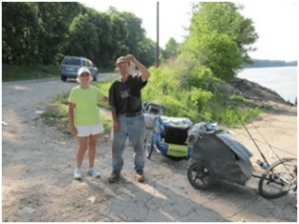
I encountered this homeless man on the Katy Trail one morning. I greeted him kindly as I ran past him – because I’m a runner, not out of fear – okay, FINE – it was both.
Later, I saw a man standing next to his bike talking to him. When I passed them, I couldn’t help but think about how I had avoided him, excusing it as a safety measure on my part. After all, the trail was secluded, and no one else was around at the time.
However, when I got home, I enlisted my husband to help me pack some food and water and take it to him. We found him trying to fish with a string and a hook and talked with him for a while before he went on his way. I’m pretty sure I did all that out of guilt and felt the Holy Spirit’s nudging when I tried to get past him on the trail that morning.
The point is, as I am continually reminded, it isn’t enough to throw a few coins from the safety of your car. Your brother or sister needs touch. They need the love that says you care. They need to see and feel the tender love of Christ. Have you heard the expression, “You may be the only Christ a person meets”? Think about that.
Forgiveness:
This is probably the hardest one of all, especially if what you are teaching your children to forgive seems unforgivable to you. But how do they know? Have you taught them that? Did you tell them you don’t visit Uncle Jim because he did something awful to you and you can’t stand him? Do you talk about the neighbor you hate or the friend you don’t see anymore because of some grievance you have against them? Then one day, your daughter comes home from school and tells you she hates her once best friend for whatever reason, and you tell her that it’s not nice to hate?
Countless times I said to my kids, “Hate’s a strong word. We don’t use that word”, while for years, I hated my mother and others who abused me. I am gradually learning to forgive those who hurt me deeply and to seek forgiveness from those I hurt in the past and sometimes still do. We need to realize and teach them that you can’t truly forgive without the grace of God.
Compassion:
God could have kept Jesus safely at home, sparing both Son and Father the agony they’d soon be suffering. But those who had been cast aside by society desperately needed Jesus up close and personal. The woman who came to the well after all the other women had shunned her. The leper who’d been sent into a lonely, humiliating exile. The adulterous woman, shamed and frightened, stood half-naked before a self-righteous crowd eager to stone her. All of them, and so many more, needed Jesus’ loving touch, which the world rejects because it’s beneath them.
As we grow into the people God created us to be, made in his likeness, we must accept the call to share that love with others – not as a burden, but as a blessing. Jesus said, “Take My yoke upon you and learn from Me, for I am gentle and lowly in heart….” (Matthew 11:29).
We are all undeserving, yet we receive God’s compassion and mercy unconditionally. He calls us to reach out to others in the same way. The world would have us believe that it’s dangerous to reach out to others, especially strangers. But, as Mother Theresa says, “Do it anyway”.
Here’s an important question to reflect on: Could you or I have compassion for someone in need if no one was watching?
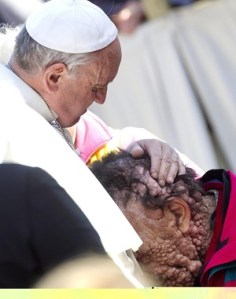
Of course, the Pope knows everyone is watching him, and this picture makes a lovely photo op. But, I think few people doubt Pope Francis’ empathy and compassion. It is truly genuine, and we know it.
Someone snapped a picture of Officer Larry DePrimo after he bought boots and thermal socks for a homeless man. He didn’t do it because someone was watching or because he would gain anything for himself. He did it because he cared. Plain and simple.

Acceptance:
Our kids are often more accepting of others than we are. I don’t know why it’s so difficult for us, but it is. We can’t accept the jerk next door that spews profanity at everything from his crabgrass to the mail carrier to his wife…and you, of course. I can find something wrong with everyone I know, myself included, if I’m honest, because the list of the things that make me the mess that I am is very long.
Think about the time your shitty old neighbor moved. You hope against hope the new ones will be different. They seem normal. Then they do something stupid by your standards, and suddenly, they become an instant ass; the honeymoon is over, and you want to take back that “Welcome to the neighborhood” plate of cookies.
If we could only grasp these profound words of Richard Rohr, “Once we have learned to discern the real and disguised nature of both good and evil, we recognize that everything is broken and fallen, weak and poor—while still being the dwelling place of God….That creates the freedom to love imperfect things! As Jesus told the rich young man, “God alone is good!” (Mark 10:18). In this, you may have been given the greatest recipe for happiness for the rest of your life.”
Humility:
“Love does not get puffed up” (1 Corinthians 13:4) Puffed-up love, or pride, is always turned inward. I know all about pride because I once made an almost effortless transition from self-hatred to self-love. Not the self-love God refers to in Mark 12:31. The self-love I’m talking about hides within the ego and thrives on a superior self-image. That’s not what God had in mind when he modeled humility in the life and death of Jesus. He became “the least of these”.
Would I do that? Would my child?
Trust:
This has always been a huge one for me.
Are you trustworthy? Because if you’re not, it stands to reason that you will not trust others and find yourself cynical of their motives. Do your children trust you?
I learned very early about trust. Once, I hid the key to our bathroom because I wanted a safe place to run to when my mother had one of her frequent angry fits. Soon after that, while my brother and I were playing, I cursed, and he ran home to tell our mother. I ran past him, flew into the house, and locked myself in my safe place. There was a pounding on the door.
“Linda, open the door.”
“No. You’ll hit me!”
“I said open the door!”
“Promise you won’t hit me.”
“Open the g@#*^ door, or I’ll climb in the window!”
“Promise you won’t hit me!”
“Okay, I promise. Now open the door!”
Trusting her – after all, she was my mother, right? – I opened the door. She beat me until I fell into the bathtub and continued beating me until she was convinced I had learned my lesson. Well, I did learn a lesson that day: don’t trust anyone. It was a lesson that would stay with me for many years. I instantly determined that no one would hurt me like that ever again.
Why is it that we’ll trust people who have no interest whatsoever in us or our well-being, yet we can’t seem to trust the One who died for us? How many of your four hundred Facebook “friends” care about your salvation? Do you think they care that you struggle? Do you think for a moment they wonder how you’re doing? “Gee, that’s a shame about Linda’s brush with hell” – yawn.
Though I kept God at arm’s length for a long time, gradually, he got through to my hardened heart. Gradually I began the process of turning loose of those things that – truth be told – I never had control of anyway. Finally, I was beginning to trust that he might just be wiser than me.
As I have grown closer to God, I have come to hear his voice more clearly, trust his guidance more readily, and wait a bit more patiently when he is silent. Yet, what is critical to understand in all of this is that I still fall short. Just when I believe I have overcome my defensive attitude, someone pushes my button and sets me off. And the insecure Linda I try to keep locked up is revealed. Busted!
So, there are the six virtues I wish I had learned as a child from loving, virtuous parents. They are the virtues I should have modeled to my own kids. They never saw it then; I hope and pray they and my grandkids do now.
When we fail – and we do, as will our kids – discouragement will become our constant companion if we do not accept the fact that we will never be perfect, and neither will they. Because I could not believe that in the past, I felt I was continually failing God when I couldn’t control or discipline myself, my husband, my kids, or the dog. But, as shocking as it may seem, the greatest commandment is not, “Get your act together, stupid!”
And as for our children, sure, we want them to grow up with moral fortitude and integrity, but we also have to accept that it might not happen the way we envision it. There are no guarantees.
God has lent us our children. They don’t belong to us, they belong to him, and he wants them back in the same “condition” we received them. Of course, he knows we aren’t the only ones influencing their behavior. He does not hold us accountable for the possibility that others may lead them astray. I’m sure there were people in my earlier years (I’m thinking of some of my teachers) who wouldn’t have given me a snowball’s chance in hell of staying out of jail! Well….

The days of raising my children have long passed, and lest I forget, they’re quick to remind me of that fact. But if I did have it to do over, I would have first learned to love them unconditionally because of God’s unreserved love for me. I would have accepted them as the individuals they were created by God to be, faults and all, because that’s how God created and accepted me. And I would not have felt such a need to control the hell out of them!
That brings us to my final thought: that ONE HUGE COMMAND that Jesus left to his disciples and us.
The GREATEST of these…is…
Drum roll, please….
LOVE – “A new commandment I give to you, that you love one another; as I have loved you.” If the basis of all we do as parents, spouses, friends, and neighbors is to love as we are called to, our children will be just fine.


 PASSION, PURPOSE & POOPYHEADS