


Let’s take a look back shall we? Have you ever wondered how the piety of Jesus’ early followers evolved into the self-righteousness we witness today? Do we, if we proclaim to be followers of Christ, believe that mandates enacted by man were Jesus’ way of “doing” religion?
I’m no Scripture Scholar (duh), but I don’t think anyone has to be to question this colossal sleight-of-hand by those in power since the time of Jesus and his apostles. And we who have been led to assume that we are superior to anyone who does not adhere to our beliefs have let our egos run amuck.
A real Scripture Scholar, Stephen Patterson, tells us, “The original believers embraced Jesus’ radical social message – something we know because they were killed by the state as traitors. They were committed to giving up old identities falsely acquired on the basis of baseless assumptions – Jew or Greek, slave or free, male or female – and declared themselves to be children of God. The Jesus movement grew from a community that dared to proclaim that there is no us, no them. We are all children of God. It was about solidarity, not cultural obliteration.”
Diana Butler Bass emphasizes Patterson’s words, ‘We are all children of God. You and your neighbor and immigrants and believers of other faiths and Democrats and Republicans…and…and…and. We are all children of God. It doesn’t sound like any Christianity we know. But it is what Jesus preached. What Paul shared in his letters. And it was what the first Christians gave their lives for – a world of human dignity and equality for all children of God – where walls are torn down and bridges built in their stead. And if that’s what a “Christian America” could mean, then count me in.” Me too! But it hasn’t always been that way.
At the beginning of my faith journey, I walked lockstep, conforming to the “rules” because the Church knows what’s best for us, right? Truth be told, I loved feeling superior to others. I did not question any of it. If you did not play by the rules, I could admonish you with a straight face, “Yeah, you’re going to hell. Have a nice trip. Not sorry.”
Where did it all go wrong? In the First Century, Saint Irenaeus took it upon himself to save the poor naïve masses from the Gnostics who “…cunningly allure the simple-minded to inquire into their system, but they nevertheless clumsily destroy them…and these simple ones are unable, even in such a matter, to distinguish falsehood from the truth”. Does being called “simple-minded” offend you in any way? It should – it offends me immensely!
One way of keeping control was to discourage the “unqualified” laity from reading the Bible. They needed their pastors to interpret it for them, poor, inept souls. The BS meter should have gone off on that one!
My three years of study at Aquinas began with challenging my beliefs about everything! Then, I came to the realization that I, like many Christians, had been duped into blindly accepting religion as certitude about so many aspects of faith that I grew to realize God never intended.
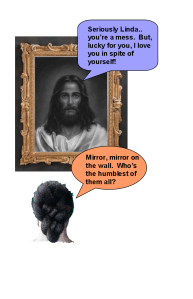
So what happened to Jesus? He seems to have gotten lost somewhere in the smoke and mirrors. Who is he to us? “Who do you say I am?” (Matt 16:13) is the ultimate question he still asks us today. Everyone who knows the name Jesus must answer that question. Those who turn their backs say, “You are no one to me.” Some espouse it verbally, while others do so more subtly through their actions.
Every Christian must answer the question, “Who is Jesus – and does he guide my life?” I believe when we answer that question, our “shoulds” must be confined to us alone. Our words and actions should come from the depths of our hearts, where God resides. He does not recognize those who profess what they do not live.
Bidden or not bidden, Jesus is always and everywhere among us. The purest and most perfect act of worship is to go out into the world and do what he did for others. Central to what he did was to care for the poor, the outcast, the lost and rejected, with no regard for what others would ultimately do to him. “Do what you must,” his life would say, “I can only respond to you in love.”
We must surely ask ourselves if we believe in and recognize the intrinsic worth of everyone. That will require all the truth and vulnerability we can muster. Have we replaced Jesus’ Sermon on the Mount (Matt 5:3-16) with a sense of superiority? If God looked deep inside our hearts, what would he find?
“If you hate a person, you hate something in him that is part of yourself. What isn’t part of ourselves doesn’t disturb us.” Herman Hess
We are currently facing a hard truth that Christians can no longer ignore. We are in the midst of our day of reckoning. The extensive history of involvement in racism and bigotry by Christian faiths, which has escalated in our time, has brought about a frightening reality. Sadly, when the Church writ large condones or turns a blind eye to these atrocities, it is no surprise that some followers feel emboldened to do the same.
We must look honestly, by the guidance of the Holy Spirit, for the truth of our beliefs and the basis of our actions. Perhaps we don’t consider ourselves racist or bigoted, but do we have the courage to confront family members, neighbors, or coworkers, or even our churches, especially our churches, if they are? Or do we remain silent?
Right now, not on some far-off, questionable “Judgment Day,” we are all being called to account for how we have treated our fellow humans. God help us if we don’t get this right soon.










 PASSION, PURPOSE & POOPYHEADS