

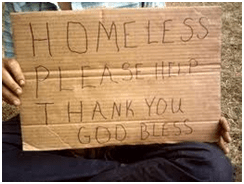
What is it that bothers us most about that homeless person standing on the corner? In a word – they’re “inconvenient.” They show up and shake our complacency to its core. Why can’t they just stay out of sight, get a job, or stand with their signs somewhere else? Who believes they’re really needy anyway? Or, if we do give them our hard-earned money, they’ll probably use it for drugs or alcohol. Why do we work so hard to justify our negative reactions to them?
I am willing to share my own shameful story here. It happened several years ago, but I have never forgotten it because it taught me a profound lesson. One day, I came to a stoplight at a highway exit. Because I missed the light, I was forced to sit uncomfortably, making every effort to disregard the homeless woman on the corner. It was 104° in the shade, and the light took forever to change! I chose to
ignore her because she’s there a lot, and I have given her money in the past. I didn’t feel obliged this time.
Finally,I pulled away and went straight to Panera Bread for lunch. Panera Bread is my favorite place to eat out. Anyway, as I looked down at my lovely salad, the guilt was so immense I could barely get my food down. Here I was with my hardness of heart exposed, listening remorsefully to God’s admonishments and offering my feeble response, “I’m so sorry, Lord. I did it again. I am so sorry!”
I packed up my half-eaten salad, got in my car, and prayed as I drove toward the overpass where she stood, “Please be there.” She was still there! You would think I won the lottery. I quickly turned around and exited again, where she was standing. All the while, digging in my purse for money. $10? No! This was at least a $20 transgression. Yes, $20. Like God would be more impressed with that. I’m a moron!
When I got to her, I handed her the money, hugged her sweaty, dirty body, returned the blessing she offered me first, and ran back to my car full of self-adulation. However, God wasn’t done with me. This lesson was just beginning. It is said that life repeats its lessons over and over until we get them. And I am, hands down, to God’s dismay, the world’s slowest learner.
That very evening of my encounter with the smelly likes of Jesus, I met with some friends. How we got on the subject of the homeless…only God knows. We barely finished our greetings when my “friend” sitting across from me began to spew her indignation toward those nasty homeless people who have the nerve to interrupt her life! If she was going to give any of them money, she wanted to control what they did with it.
I listened to her rail against them and mumbled under my breath, “Lord, really? Did you set this up? It would be just like you! Fine. Can I get a beer, because this is going to take a while, isn’t it? By the way, have I said how sorry I am that we had to revisit my cold, hard indifference to those you love so deeply?”
I then had an hour’s drive home to ponder it all. In particular, my hesitation to discuss it with the woman at our meeting (she’s not really my friend anyway). The words God spoke to my heart penetrated my very soul, “Woe to you, Linda. You hypocrite! Don’t even think about judging her!” Right, okay, I have no right to judge anyone. But, what I wanted to say to her – I needed to hear myself.
So here it goes…We have our favorite defenses against helping the homeless. The most common seem to be:
- I can’t help everyone.
- It’s not my responsibility.
- I want to know what they are going to do with the money.
- They’re lazy; they need to get a job.
- Or, my all-time favorite: Let’s put it on God. – “LORD, WHY DON’T YOU DO SOMETHING?!”
As I considered the reasons we hold our clenched fists so tightly around our measly handful of change, I had a picture of me sitting at a long table. There was a line of homeless people on the other side of the table. Each one approached and stood
there as I grilled them to determine if they were worthy of my precious coins. Most I would usher off to the right, UNDESERVING. A few I would send to the left, DESERVING, where I would hand them a few tokens and expect their undying gratitude.
Then, I saw Jesus sitting at that same table. Now I was in line. I watched as each person approached in trembling anticipation. But, it wasn’t money he was handing out, it was grace. Most he would ruthlessly question, “What have you done to deserve this? What will you do with it? Why should I give it to you?” – then gesture to the right, UNDESERVING. A few would be sent to the left and showered with more grace and blessings than they could contain! I quickly got out of line and ran home to get a suitcase, certain I was going to the left, and prepared to capture all the blessings Jesus would bestow on me. I was pumped!
Finally, I reached the front of the line, and without hesitation, Jesus looked at my pathetic life and gestured to the right, UNDESERVING. Slumped over in disbelief, dragging my empty suitcase behind me, I fell into line with the unworthy masses.
So many of us live our lives in the realm of worthy vs. unworthy. It categorizes who we are, who our neighbors are, and who the poor are. And when we can muster just a smidgen of concern for others, we raise our voice to the heavens in outrage, “Lord, I don’t know how you can just sit there and watch your people suffer.”
What we fail to remember is that God came into our midst to reveal a different reality. He gives and gives abundantly, even to my sorry self. Not one of us is deserving. We ask for his mercy, grace, and forgiveness, and it is ours. There are no lines to stand in. There is no reason to doubt or fear. The abundance of God’s grace is beyond measure. The riches of his generosity have no limits. But we, like the unforgiving servant (Matthew 18:21-35), quickly forget.
Jesus came to serve. He commissioned His disciples to “feed my sheep.” In Matthew’s gospel (14:13-21), five thousand people converged on Jesus. His disciples insisted that he send them home to feed themselves. And what was Jesus’ reply? “You feed them. You do it!” God provided…and all the people were given their fill, with food to spare.
The fact that there are people starving and dying every day is not because of poor planning on God’s part. It’s because many of us who have been given much give little in return (Luke 12:48). The love God calls us to requires us to love everyone. Loving
them means caring for them and giving generously from our abundance of blessings.
And, for the love of God, stop judging them!





 PASSION, PURPOSE & POOPYHEADS