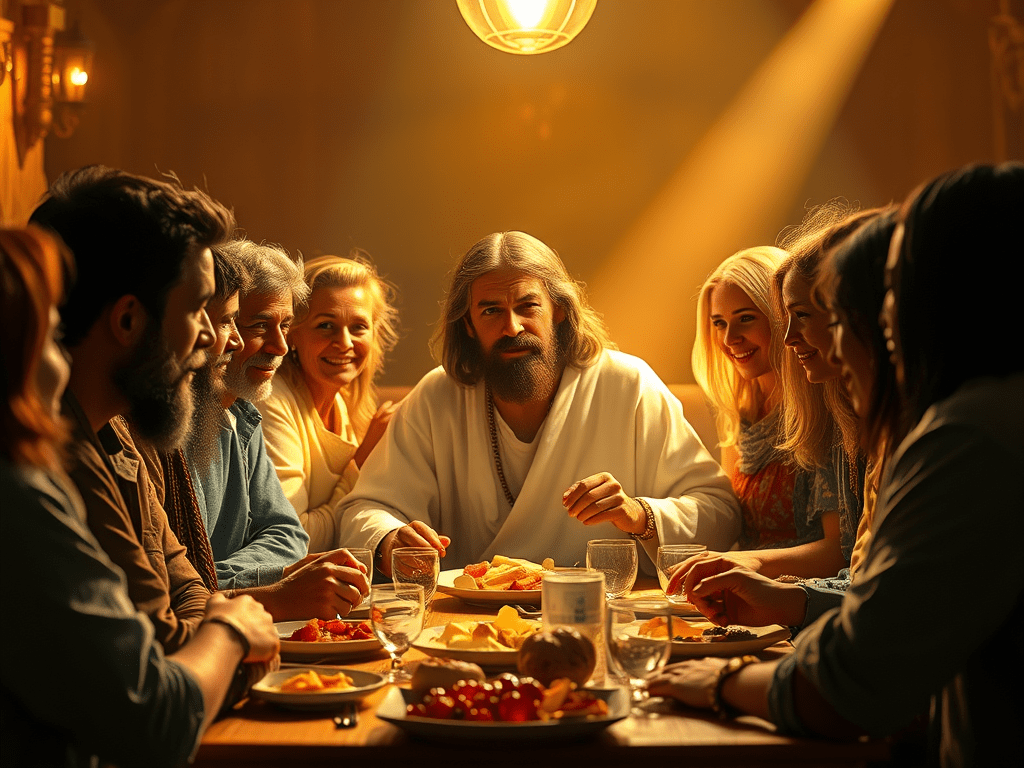
Luke 14:12-23

My mother, God rest her soul, was a terrible cook. There were specific meals for specific days. I only recall Meatloaf Monday, but every day was a dull repeat of the previous week. Oh yeah, the meatloaf was topped with peas. I hate peas to this day!
When my mom worked late, my dad stepped in and provided do-it-yourself bologna sandwich fixings and ice cream. Always ice cream. Those were peaceful, quiet meals. Disgusting, yes, but peaceful. I didn’t appreciate that at the time. (It seems I carried on that bologna tradition. My daughter recalls eating a lot of bologna sandwiches growing up. I don’t remember that. I think she was exaggerating. But I did apologize to her for ruining her digestive system!)
I have not touched bologna since I was a kid, but ice cream is my favorite comfort food. I’m sure it’s because I can remember sitting on the couch with my dad, watching TV, and eating it. Though I don’t recall having a meaningful relationship with him. He was not abusive like my mother, but quiet and reserved. One day, when my mom was yelling at him for something, I heard him say, “If it wasn’t for the kids, I would have left you a long time ago.”
I have no doubt there was a lot of unhappy “stuff” going on inside of him that we were not privy to. Except that I know his family of origin was terribly dysfunctional, as was my mother’s. Which is likely the reason there was no closeness, tenderness, or favorite moments with either of them. This causes me to wonder which was worse: the abuse or indifference?
I also don’t recall sharing meals with anyone else, not family or friends. We never had company at our house or visited anyone else’s house for a meal. My parents were members of a dance club and often socialized with their friends, but we were never a part of that.
So, when I read Father Rohr’s meditation, “Come to the Table,” I was moved to tears. At first, they were tears of sadness for my experience as a child. But then moved to a more profound sadness about how the Church turned that open table into an exclusive club for those who belonged, not for the “others,” the “outsiders” who did not. Just the opposite of what Jesus taught.
Here’s what I find so contradictory: IF the bread is literally turned into the body of Christ, then wouldn’t it be available to “everyone” since Jesus invited “everyone” to the table? I wish someone could explain that to me.
I will leave you with Richard Rohr’s thoughts:
“It’s necessary to calculate very carefully what was lost and what was gained as Christianity developed. The Church moved from Jesus’ real meal with open table fellowship to its continuance in the relatively safe ritual meal that became the Christian Eucharist. Unfortunately, the meal itself came to redefine social reality in a negative way, in terms of worthiness and unworthiness.
That is almost exactly the opposite of Jesus’ intention….Isn’t it strange that sins of marriage and sexuality are the primary ones we use to exclude people from the table, when other sins like greed and hatefulness that cause more public damage are never considered?
The gospel doesn’t need a coalition devoted to keeping the wrong people out. It needs a family of sinners, saved by grace, committed to tearing down the walls, throwing open the doors, and shouting, “Welcome! There’s bread and wine….” This isn’t a kingdom for the worthy; it’s a kingdom for the hungry.” Richard Rohr
 PASSION, PURPOSE & POOPYHEADS